The Doob-Meyer decomposition was a very important result, historically, in the development of stochastic calculus. This theorem states that every cadlag submartingale uniquely decomposes as the sum of a local martingale and an increasing predictable process. For one thing, if X is a square-integrable martingale then Jensen’s inequality implies that 


The approach taken in these notes is somewhat different from the historical development, however. We introduced stochastic integration and semimartingales early on, without requiring much prior knowledge of the general theory of stochastic processes. We have also developed the theory of semimartingales, such as proving the Bichteler-Dellacherie theorem, using a stochastic integration based method. So, the Doob-Meyer decomposition does not play such a pivotal role in these notes as in some other approaches to stochastic calculus. In fact, the special semimartingale decomposition already states a form of the Doob-Meyer decomposition in a more general setting. So, the main part of the proof given in this post will be to show that all local submartingales are semimartingales, allowing the decomposition for special semimartingales to be applied.
The Doob-Meyer decomposition is especially easy to understand in discrete time, where it reduces to the much simpler Doob decomposition. If 

![\displaystyle \setlength\arraycolsep{2pt} \begin{array}{rl} \displaystyle X_n&\displaystyle=M_n+A_n,\smallskip\\ \displaystyle A_n&\displaystyle=\sum_{k=1}^n{\mathbb E}\left[X_k-X_{k-1}\;\vert\mathcal{F}_{k-1}\right]. \end{array}](https://s0.wp.com/latex.php?latex=%5Cdisplaystyle++%5Csetlength%5Carraycolsep%7B2pt%7D+%5Cbegin%7Barray%7D%7Brl%7D+%5Cdisplaystyle+X_n%26%5Cdisplaystyle%3DM_n%2BA_n%2C%5Csmallskip%5C%5C+%5Cdisplaystyle+A_n%26%5Cdisplaystyle%3D%5Csum_%7Bk%3D1%7D%5En%7B%5Cmathbb+E%7D%5Cleft%5BX_k-X_%7Bk-1%7D%5C%3B%5Cvert%5Cmathcal%7BF%7D_%7Bk-1%7D%5Cright%5D.+%5Cend%7Barray%7D+&bg=ffffff&fg=000000&s=0&c=20201002) |
(1) |
As previously discussed, M is then a martingale and A is an integrable process which is also predictable, in the sense that 


![{{\mathbb E}[X_n-X_{n-1}\vert\mathcal{F}_{n-1}]\ge0}](https://s0.wp.com/latex.php?latex=%7B%7B%5Cmathbb+E%7D%5BX_n-X_%7Bn-1%7D%5Cvert%5Cmathcal%7BF%7D_%7Bn-1%7D%5D%5Cge0%7D&bg=ffffff&fg=000000&s=0&c=20201002)
Moving to continuous time, we work with respect to a complete filtered probability space 
Theorem 1 (Doob-Meyer) Any local submartingale X has a unique decomposition
(2) where M is a local martingale and A is a predictable increasing process starting from zero.
Furthermore,
- if X is a proper submartingale, then A is integrable and satisfies
(3) for all uniformly bounded stopping times
.
- X is of class (DL) if and only if M is a proper martingale and A is integrable, in which case
(4) for all uniformly bounded stopping times
- X is of class (D) if and only if M is a uniformly integrable martingale and
is integrable. Then,
and
exist almost surely, and (4) holds for all (not necessarily finite) stopping times

![\displaystyle {\mathbb E}[A_\tau]\le{\mathbb E}[X_\tau-X_0]](https://s0.wp.com/latex.php?latex=%5Cdisplaystyle++%7B%5Cmathbb+E%7D%5BA_%5Ctau%5D%5Cle%7B%5Cmathbb+E%7D%5BX_%5Ctau-X_0%5D+&bg=ffffff&fg=000000&s=0&c=20201002)
![\displaystyle {\mathbb E}[A_\tau]={\mathbb E}[X_\tau-X_0]](https://s0.wp.com/latex.php?latex=%5Cdisplaystyle++%7B%5Cmathbb+E%7D%5BA_%5Ctau%5D%3D%7B%5Cmathbb+E%7D%5BX_%5Ctau-X_0%5D+&bg=ffffff&fg=000000&s=0&c=20201002)
 be the first time at which
  , then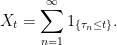
 has a Poisson distribution independently of
  , for all times
  , and for which the gaps
  between the stopping times are independent exponentially distributed random variables. As we will see, although Poisson processes are just one specific example, every quasi-left-continuous counting process can actually be reduced to the case of a Poisson process by a time change. As always, we work with respect to a
  such that
  is a
is a  , then the compensated Poisson process
  is a martingale. So, the compensator of X is the continuous process
  . More generally, X is said to be
  for all
  for a stopping time
  , in which case the compensator of X is just the same thing as
 ![{[X]_t=t}](https://s0.wp.com/latex.php?latex=%7B%5BX%5D_t%3Dt%7D&bg=ffffff&fg=000000&s=0&c=20201002) . Similarly, as we show below, a counting process is a homogeneous Poisson process of rate
. Similarly, as we show below, a counting process is a homogeneous Poisson process of rate ![{[X]_\infty}](https://s0.wp.com/latex.php?latex=%7B%5BX%5D_%5Cinfty%7D&bg=ffffff&fg=000000&s=0&c=20201002) is finite. Similarly, a counting process X has finite value
is finite. Similarly, a counting process X has finite value  at infinity if and only if the same is true of its compensator. Another property of a continuous local martingale X is that it is
  .
.  is a local martingale. Compensators of stopping times are sufficiently special that we can give an accurate description of how they behave. For example, if
  . If, on the other hand,
 are disjoint stopping times such that the union
 ![{\bigcup_n[\tau_n]}](https://s0.wp.com/latex.php?latex=%7B%5Cbigcup_n%5B%5Ctau_n%5D%7D&bg=ffffff&fg=000000&s=0&c=20201002) of their graphs contains all the jump times of X. That they are disjoint just means that
of their graphs contains all the jump times of X. That they are disjoint just means that  whenever
  , for any
  . As was shown in an earlier post, not only is such a sequence
  , on the right hand side of (
 plus the sum of the compensators of
  . The reduces compensators of locally integrable FV processes to those of processes consisting of a single jump at either a predictable or a totally inaccessible time.
  Almost Sure