In stochastic calculus it is common to work with processes adapted to a filtered probability space  . As with probability space extensions, It can sometimes be necessary to enlarge the underlying space to introduce additional events and processes. For example, many diffusions and local martingales can be expressed as an integral with respect to Brownian motion but, sometimes, it may be necessary to enlarge the space to make sure that it includes a Brownian motion to work with. Also, in the theory of stochastic differential equations, finding solutions can sometimes require enlarging the space.
Extending a probability space is a relatively straightforward concept, which I covered in an earlier post. Extending a filtered probability space is the same, except that it also involves enlarging the filtration  . It is important to do this in a way which does not destroy properties of existing processes, such as their distributions conditional on the filtration at each time.
Let’s consider a filtered probability space  . An enlargement
is, firstly, an extension of the probability spaces. It is a map from Ω′ to Ω measurable with respect to  and
and  , and preserving probabilities. So ℙ′(π-1E) = π(E) for all
  . In addition, it is required to be
  measurable for each time t ≥ 0, meaning that
  for all
  . Consequently, any adapted process Xt lifts to an adapted process X∗t = π∗Xt on the larger space, defined by X∗t(ω) = Xt(π(ω)).
As with extensions of probability spaces, this can be considered in two steps. First, we extend to the filtered probability space on Ω′ with induced sigma-algebra  consisting of sets π-1E for , and to the filtration
  . This is essentially a no-op, since events and random variables on the original filtered probability space are in one-to-one correspondence with those on the enlarged space, up to zero probability events. Next, the sigma-algebras are enlarged to
  and
and  . This is where new random events are added to the event space and filtration.
Such arbitrary extensions are too general for many uses in stochastic calculus where we merely want to add in some additional source of randomness. Consider, for example, a standard Brownian motion B defined on the original space so that, for any times s < t, Bt – Bs is normal and independent of  . Does it necessarily lift to a Brownian motion on the enlarged space? The answer to this is no! It need not be the case that B∗t – B∗s is independent of
  . For an extreme case, consider the situation where
  and π is the identity, so there is no enlargement of the sample space. If the filtration is is extended to the maximum,
  , consider what happens to our Brownian motion. The increment Bt – Bs is -measurable, so is not independent of it. In fact, conditioned on
  , the entire path of B is deterministic. It is definitely not a Brownian motion with respect to this new filtration. Similarly, martingales, submartingales and supermartingales will not remain as such if we pass to this enlarged filtration.
The idea is that, if ![{ Y={\mathbb E}[X\vert\mathcal F_t]}](https://s0.wp.com/latex.php?latex=%7B+Y%3D%7B%5Cmathbb+E%7D%5BX%5Cvert%5Cmathcal+F_t%5D%7D&bg=ffffff&fg=000000&s=0&c=20201002) for random variables X, Y defined on our original probability space, then this relation should continue to hold in the extension. It is required that
for random variables X, Y defined on our original probability space, then this relation should continue to hold in the extension. It is required that ![{ Y^*={\mathbb E}[X^*\vert\mathcal F'_t]}](https://s0.wp.com/latex.php?latex=%7B+Y%5E%2A%3D%7B%5Cmathbb+E%7D%5BX%5E%2A%5Cvert%5Cmathcal+F%27_t%5D%7D&bg=ffffff&fg=000000&s=0&c=20201002) . This is exactly relative independence of
. This is exactly relative independence of  and over .
Recall that two sigma-algebras  and
and  are relatively independent over a third
  if
if
for all  and
and  . The following properties are each equivalent to this definition;
![{{\mathbb E}[XY\vert\mathcal K]={\mathbb E}[X\vert\mathcal K]{\mathbb E}[Y\vert\mathcal K]}](https://s0.wp.com/latex.php?latex=%7B%7B%5Cmathbb+E%7D%5BXY%5Cvert%5Cmathcal+K%5D%3D%7B%5Cmathbb+E%7D%5BX%5Cvert%5Cmathcal+K%5D%7B%5Cmathbb+E%7D%5BY%5Cvert%5Cmathcal+K%5D%7D&bg=ffffff&fg=000000&s=0&c=20201002) for all bounded -measurable random variables X and -measurable Y.
for all bounded -measurable random variables X and -measurable Y.![{{\mathbb E}[X\vert\mathcal G]={\mathbb E}[X\vert\mathcal K]}](https://s0.wp.com/latex.php?latex=%7B%7B%5Cmathbb+E%7D%5BX%5Cvert%5Cmathcal+G%5D%3D%7B%5Cmathbb+E%7D%5BX%5Cvert%5Cmathcal+K%5D%7D&bg=ffffff&fg=000000&s=0&c=20201002) for all bounded -measurable X.
for all bounded -measurable X.![{{\mathbb E}[X\vert\mathcal H]={\mathbb E}[X\vert\mathcal K]}](https://s0.wp.com/latex.php?latex=%7B%7B%5Cmathbb+E%7D%5BX%5Cvert%5Cmathcal+H%5D%3D%7B%5Cmathbb+E%7D%5BX%5Cvert%5Cmathcal+K%5D%7D&bg=ffffff&fg=000000&s=0&c=20201002) for all bounded -measurable X.
for all bounded -measurable X.
This leads us to the idea of a standard extension of filtered probability spaces.
Definition 1 An extension of filtered probability spaces
is standard if, for each time t ≥ 0, the sigma-algebras and are relatively independent over .
Continue reading “Extending Filtered Probability Spaces” →

![\displaystyle {\mathbb P}(A\cap B) = {\mathbb E}\left[{\mathbb P}(A\vert\mathcal K){\mathbb P}(B\vert\mathcal K)\right]](https://s0.wp.com/latex.php?latex=%5Cdisplaystyle+%7B%5Cmathbb+P%7D%28A%5Ccap+B%29+%3D+%7B%5Cmathbb+E%7D%5Cleft%5B%7B%5Cmathbb+P%7D%28A%5Cvert%5Cmathcal+K%29%7B%5Cmathbb+P%7D%28B%5Cvert%5Cmathcal+K%29%5Cright%5D+&bg=ffffff&fg=000000&s=0&c=20201002)

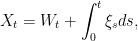
 , defined with respect to a filtered probability space
  . For this to make sense, we must assume that
  is almost surely finite at all times, and I will suppose that
  is the filtration generated by W.
 is not almost surely zero). In this case X has exactly the same distribution as W, so cannot be distinguished from the driftless case with
  by looking at the distribution of X alone.
 and
and  . This allows us to back out the drift
  to be the filtration generated by a standard Brownian motion W in
  , and we define
  , can we find an
  such that the filtration generated by
  is smaller than
  Almost Sure