Probability and measure theory relies on the concept of measurable sets. On the real numbers ℝ, in particular, there are several different sigma-algebras which are commonly used, and a set is said to be measurable if it lies in the one under consideration. Probabilities and measures are only defined for events lying in a specific sigma-algebra, so it is essential to know if sets are measurable. Fortunately, most simply constructed events will indeed be measurable, but this is not always the case. In fact, once we start working with more complex setups, such as continuous-time stochastic processes observed at random times, non-measurable sets occur more commonly than might be expected. To avoid such issues, it is usual to enlarge the underlying sigma-algebra defining a probability space as much as possible.
The Borel sets form the smallest sigma-algebra containing the open sets or, equivalently, containing all intervals. This is denoted as 

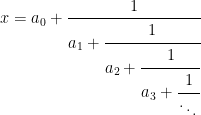 |
where a0 is an integer and ai are positive integers for i ≥ 1. Lusin considered the set of irrationals whose continued fraction coefficients contain a subsequence ak1, ak2, … such that each term is a divisor of the subsequent term.
Other examples can be given along similar lines to Lusin’s. Every real number has a binary expansion
 |
where a0 is an integer and ai is in {0, 1} for each i ≥ 1. Consider the set of reals having a binary expansion for which there is an infinite sequence of positive integers k1, k2, …, each term strictly dividing the next, such that aki = 1. I will give proofs that these examples are non-Borel in this post.
There is a general method of enlarging sigma-algebras known as the completion. Consider a measure μ defined on a measurable space 


The Lebesgue measure λ is uniquely defined on the Borel sets by specifiying its value on intervals as λ((a, b)) = b – a. The completion 

While the Lebesgue measure extends uniquely to 
 |
The intersection is taken over all sigma-finite measures μ on 
Finally, the power set 
 |
(1) |
In this post, I show that each of these inclusions is strict. That is, there are subsets of the reals which are not Lebesgue measurable, there are Lebesgue sets which are not in the universal completion
Vitali Sets
Vitali sets are a common example of non-measurable sets. We can define an equivalence relation x ∼ y on the real numbers which holds whenever x – y is rational. This partitions ℝ into a collection of equivalence classes, which consist of sets of the form ℚ + x, equal to all numbers differing from x by a rational number. A Vitali set S is any set containing a single element of each equivalence class. That is, every real number x differs from exactly one element of S by a rational amount. This is not an explicit construction, since it requires the axiom of choice to select a unique element of each equivalence class but, as we will see, this is by necessity.
For each rational number q, let Sq consist of the elements of S + q taken modulo 1. That is, each element x ∈ S is mapped to the unique y ∈ [0, 1) such that x + q – y is an integer. If S was Lebesgue measurable, then Sq would also be Lebesgue, which we can see by writing
 |
For any distinct pair of rational numbers q, r ∈ [0, 1), the sets Sq and Sr are disjoint. For any element x of their intersection, both x – q + m and x – r + n would lie in S for integer m, n, which is not possible as they are distinct elements of the same equivalence class. Also, for any x ∈ [0, 1), the equivalence class ℚ + x contains an element of S and, so, x – q ∈ S for some rational q, giving x ∈ Sq. Hence,
 |
and, if S was Lebesgue measurable, countable additivity gives
 |
(2) |
For any pair of rationals q, r, the set Sr is just Sq + r – q modulo 1. By translation invariance of the Lebesgue measure λ(Sq) = λ(Sr) if these are measurable. This contradicts (2). If λ(Sq) was positive, then it gives an infinite sum of equal positive terms, which is infinite. If λ(Sq) was zero, then the sum is zero. In either case, the sum is not 1 so (2) cannot hold. Hence, λ(Sq) is undefined and S is not Lebesgue measurable.
We have constructed subsets of ℝ which are not Lebesgue measurable, so the final inclusion of (1) is strict. Any example S of a non-Lebesgue set is easily modified to give an example of a Lebesgue set which is not in the universal completion
As f(S) is contained in a Lebesgue-null set, it is Lebesgue measurable. To show that it is not in 
 |
If f(S) was in
It just remains to find a one-to-one measurable function f: ℝ → ℝ whose image is Lebesgue-null. An example is the map which takes the binary expansion of a real number and re-interprets it as a decimal expansion. That is, every real number x has a unique binary expansion
 |
for integer a0 and ai ∈ {0, 1} for i ≥ 1, which does not terminate with repeating 1’s. This last constraint is required to ensure that the binary expansion is unique. Then,
 |
This is clearly one-to-one and, since Lebesgue almost-every real number contains decimal digits other than 0 and 1 (in fact, they are normal), the image of f is Lebesgue-null. For any Vitali set S, f(S) is an example of a Lebesgue set which is not in
The Solovay Model and Axiom of Choice
I constructed sets above which are not Lebesgue measurable, and sets which are Lebesgue but not universally Borel measurable. These constructions based on Vitali sets made essential use of the Axiom of Choice. You may wonder if this is necessarily the case. The answer is yes, as shown by the Solovay model. This is a model of Zermelo-Fraenkel (ZF) set theory in which the axiom of choice does not hold, although dependent choice does, which is sufficient for almost all measure and probability theory.
The important property of the Solovay model for us is that every subset of the real numbers is Lebesgue measurable. This is a very strong statement indeed! If we were to always work within the axiomatic framework of this model of set theory, many technical difficulties encountered in measure theory magically vanish. In fact, it has been proposed that this should be used as the standard framework, especially for measure theory.
So, under the Solovay model, the right hand inclusion in (1) would no longer be strict. Vitali sets simply wouldn’t exist. We can go further though, and show that all subsets being Lebesgue actually implies that they are in
Consider any atomless probability measure μ on the Borel sigma-algebra, so that μ({x}) = 0 for all points x. Define its cumulative distribution function
![\displaystyle F(x)=\mu((-\infty,x])](https://s0.wp.com/latex.php?latex=%5Cdisplaystyle+F%28x%29%3D%5Cmu%28%28-%5Cinfty%2Cx%5D%29+&bg=ffffff&fg=000000&s=0&c=20201002) |
which is continuous and increasing from 0 to 1. Then μ(F-1A) = λ(A) for all Borel A ⊆ [0, 1]. Also, let U ⊆ ℝ be the union of the intervals on which F is constant, which is Borel with zero μ-measure. Any subset A of the reals satisfies F-1F(A) ∖ U ⊆ A ⊆ F-1F(A).
For any subset S ⊆ ℝ, F(S) is Lebesgue by assumption, so there exists Borel sets A ⊆ F(S) ⊆ B with λ(B ∖ A) = 0. Then A′= F-1A ∖ U and B′= F-1B are Borel with A′ ⊆ S ⊆ B′ and μ(B′ ∖ A′) = 0. Hence, S is in the completion
Next, if μ is any finite measure on the Borel sigma algebra, let A ⊆ ℝ be its set of atoms, x ∈ ℝ with μ({x}) > 0, which is countable. Its restriction ν to ℝ ∖ A is atomless and, by the above, all subsets of ℝ are in 

Under the Solovay model, we see that 
Non-Borel sets can be constructed without appealing to uncountable choice by, instead, using a ‘diagonalization’ argument. The idea is that 
 |
cannot be Borel. If it was, it would equal Bx for some x ∈ ℝ, giving the contradiction: x ∈ Bx iff x ∉ Bx.
Creating non-Borel sets in this way, without uncountable choice, demonstrates that the inequality 
Analytic Sets
One method of constructing non-Borel sets which are universally measurable is via the theory of analytic sets developed by Lusin. Before detailing such a construction, I go over some of theory first. Just the minimal amount required for our purposes.
Use ℕ = {1, 2, …} to denote the natural numbers (excluding zero, which will be convenient here) and N = ℕℕ for Baire space consisting of infinite sequences of natural numbers. This can be given the product topology, so that a sequence an ∈ N converges to a limit b if, for each k, the k‘th terms (an)k are eventually equal to bk. This is homeomorphic to the space of irrational numbers in the unit interval (0, 1) with the standard topology by continued fractions,
 |
It can be seen that N is a Polish space — that is, separable and completely metrizable. Specifically, the set of sequences which eventually terminate in repeating 1’s is countable and dense, showing that it is separable, and a complete metric can be defined by
 |
While there are many different ways of defining analytic subsets of a Polish space, the following will be useful here. For the cartesian product X × Y of sets, I use π: X × Y → X to denote the projection (x, y) ↦ x.
Definition 1 A subset A of Polish space X is analytic if it is equal to π(S) for some closed subset S of X × N .
It can immediately be seen that Lusin’s set described at the top of this post is analytic. Let X ⊆ ℝ be the irrational numbers and S ⊆ X × N be the pairs (x, c) such that (c1, c2, …) is strictly increasing and such that the continued fraction coefficients a0, a1, … are such that each acn divides acn+1. This is closed and π(S) is Lusin’s set which, therefore, is analytic.
A first property of analytic sets is that they are closed under countable unions and intersections.
Lemma 2 The collection of analytic subets of a Polish space X is closed under countable unions and under countable intersections.
Proof: If A1, A2, … is a sequence of analytic sets, then there exists a sequence S1, S2, … of closed subsets of X × N such that An = π(Sn).
Consider S ⊆ X × N consisting of pairs (x, a) where a = (n, b1, b2, …) for some n ∈ ℕ and (x, b) ∈ Sn. This is closed and x ∈ π(S) iff there exists n ∈ ℕ and b ∈ Sn such that (x, b) ∈ Sn. Equivalently, x ∈ π(Sn) = An. So,
 |
is analytic.
Next, let θ: ℕ × ℕ → ℕ be a bijection. Then define S ⊆ X × N to consist of pairs (x, b) such that the sequence a1, a2, … ∈ N given by (an)m = bθ(m,n) satisfies (x, an) ∈ Sn for all n ∈ ℕ. This is closed and x ∈ π(S) iff there exists a sequence a1, a2, … ∈ N such that (x, an) ∈ Sn for all n ∈ ℕ. Equivalently, x ∈ π(Sn) = An. So,
 |
is analytic as required. ⬜
An immediate consequence is that all Borel sets are analytic.
Theorem 3 Every Borel subset of a Polish space X is analytic.
Proof: Using A for the analytic subsets of X, lemma 2 says that it is closed under countable unions and countable intersections. Also, every closed A ⊆ X is equal to π(A × N ) and, so, is in A . Furthermore, as it is a metric space, every open set is the union of an increasing sequence of closed sets. Specifically, if A is closed and, for each n we let Bn consist of the x ∈ X satisfying d(x, y) ≥ 1/n for all y ∈ A, then Bn is an sequence of closed sets increasing to X ∖ A. So, by the monotone class theorem, A contains the sigma-algebra generated by the closed sets, which are the Borel sets. ⬜
In the other direction, all analytic sets are in the universal completion of the Borel sigma-algebra.
Theorem 4 Every analytic subset of a Polish space X is in the universal completion of the Borel sigma-algebra.
For the proof of this, I refer to other posts of this blog. See, for example, theorem 10 of the post on Choquet’s capacitability theorem, or theorem 5 of the post on measurable projection. These both give proofs that π(S) is universally measurable for any measurable S ⊆ X × ℝ. As we noted above that N is homeomorphic to (0, 1) ∖ ℚ, these also apply to measurable subsets of X × N and, in particular, to any closed subset S of X × N .
Using A (X) for the analytic sets, theorems 3 and 4 are summarized by the inclusions
 |
Non-Borel Analytic Sets
Having completed the very brief introduction to analytic sets, I will now show how non-Borel examples can be constructed. We start with universal closed sets. Here, for a subset S ⊆ X × Y and y ∈ Y, I use Sy to denote the slice consisting of x ∈ X with (x, y) ∈ S.
Definition 5 For Polish spaces X, Y, a closed subset S ⊆ X × Y will be said to be universal if every closed subset of X is equal to Sy for some y ∈ Y.
We can construct universal closed sets.
Lemma 6 For any Polish space X, there exists a universal closed subset of X × N .
Proof: As X is a separable metrizable space, its topology has a countable basis U1, U2, …. For example, the balls of radius 1/n centered at points of a countable dense subset gives a countable basis. I assume that the empty set is also included in the basis, so that every open subset of X is a non-empty union of the Un.
Now let V ⊆ X × N consist of pairs (x, a) where x ∈ ⋃nUan. This is open and, as every open subset W ⊆ X can be written as a union
 |
we have W = Va. So, (X × N ) ∖ V is universal closed. ⬜
We now construct a non-Borel set as promised, which uses a diagonalization argument.
Lemma 7 Let S ⊆ N × N × N be universal closed and S′ ⊆ N × N consist of the pairs (x, y) such that (x, y, x) ∈ S.
Then, S′ is closed and A = π(S′) is an analytic subset of N whose complement N ∖ A is not analytic. In particular, A is not Borel.
Proof: By assumption, every closed subset of N × N is equal to Sx for some x ∈ N and, hence, every analytic subset of N can be written as π(Sx). If we define B ⊆ N to be the set of x ∈ N such that x ∉ π(Sx) then this cannot be analytic. If it was, it would equal π(Sx) for some x but, then, x ∈ B iff x ∉ π(Sx) is a contradiction.
The complement A = N ∖ B of the non-analytic set just constructed is given by x ∈ A iff x ∈ π(Sx). This is equivalent to (x, y) ∈ Sx for some y, or, (x, y, x) ∈ S. This is the same as (x, y) ∈ S′ , or x ∈ π(S′). So, A = π(S′) has non-analytic complement B. As B is not analytic, theorem 3 says that it is also non-Borel. ⬜
We have constructed a subset of A ⊆ N which is not Borel but, as it is analytic, is in the universal completion of the Borel sigma-algebra. Also, as was noted above, N is homeomorphic to (0, 1) ∖ ℚ and, hence, we also obtain a subset of the reals which is not Borel but is in the universal completion.
This is enough to prove the claim near the top of the post that the inequality
Lusin’s Non-Borel Set
Lemma 7 above proved the existence of universally measurable sets which are not Borel, so the first inclusion 
First, a bit of notation which will be useful. Use ℕn for the length-n sequences of natural numbers and, fo a ∈ N , use a|n ∈ ℕn for the truncated length-n sequence (a1, …, an). Also, for m ≤ n and a ∈ ℕn, use a|m ∈ ℕm for the turncated length-m sequence (a1, …, am). The disjoint union 
The following lemma expresses analytic sets in terms of infinite increasing sequences in N∗ and has some of the flavour of Lusin’s set.
Lemma 8 Let S be a closed subset of N × N . For each a ∈ ℕn, let Ha be the set of x ∈ N such that (x|n, a) = (y|n, z|n) for some (y, z) ∈ S.
Then, the indicator function 1Ha: N → {0, 1} is continuous, and x ∈ N is in π(S) if and only if there is a sequence an ∈ N∗ with an ≺ an+1 and x ∈ Han for each n.
Proof: As membership x ∈ Ha is a function of finitely many terms of x (depending only on x|n, it is continuous or, equivalently, Ha is both open and closed.
Now suppose that x ∈ π(S). Then, (x, y) ∈ S for some y and the trivial identity (x|n, y|n) = (x|n, y|n) implies, from the definition, that x ∈ Hy|n. However, an = y|n is an increasing sequence for the partial order on ℕ∗ as required.
Conversely, suppose that there is an increasing sequence an with the stated properties. Using kn for the length of an, the fact that it is increasing gives a b ∈ N with b|kn = an for each n. Also, by assumption there exists (yn, zn) ∈ S with yn|kn = x|kn and zn|kn = b|kn for each n. This implies that (yn, zn) tends to (x, b) so, as it is closed, is contained in S. Hence, x ∈ π(S) as required. ⬜
Lemma 8 refers to increasing sequences in the partially ordered set N∗. This can be transferred to increasing sequences in ℕ with the division order (each term divides the next).
Consider Cantor space C = 2ℕ which is the space of sequences (a1, a2, …) in {0, 1} with the product topology. This is a compact Polish space, using the same metric as defined above for Baire space and has the countable dense subset of sequences containing finitely many 1’s. In fact C can be identified with the closed subspace of N of sequences whose terms are all 1 or 2.
Let LC be the subset of Cantor space consisting of x ∈ C such that there is a sequence k1, k2, … of positive integers, each term strictly dividing the next, satisfying xki = 1 for each i. This is analytic, since it equals π(S) where S ⊆ C × N is the closed set consisting of pairs (x, y) where each term of y strictly divides the subsequent one and xyi = 1 for each i.
Lemma 9 Every analytic subset of N is equal to f-1(LC) for a continuous map f: N → C
Proof: The first thing is to construct a one-to-one map θ: ℕ∗ → ℕ which is an order isomorphism onto its image, using the division order on ℕ∗. That is, θ(a) divides θ(b) iff a ≺ b. This can be done by prime factorization. Let pij be distinct primes indexed by i, j ∈ ℕ. Then, for a ∈ ℕn, write
 |
If a ≺ b then θ(b) consists of multiplying the same primes as b, as well as some additional ones as b is longer, so θ(a) strictly divides θ(b). Conversely, suppose that θ(a) divides θ(b). If b ∈ ℕn then θ(b) is a product of n distinct primes. As θ(a) divides it, it must be a product of a subset of these primes which, because the pij are distinct, can only happen if a ⪯ b.
Now, consider analytic A = π(S) for closed S ⊆ N × N . Then, let Ha ⊆ N be as constructed in Lemma 8. We define f: N → C as follows. Set f(x) = y = (y1, y2, …) where yθ(a) = 1{x∈Ha} and yn = 0 for n not in the image of θ, yn = 0.
Suppose that x ∈ A. By lemma 8, there is a strictly increasing sequence an ∈ ℕ∗ with x ∈ Han. Hence, θ(an) strictly divides θ(an+1) and yθ(an) = 1 for each n. So, y ∈ LC.
Conversely, suppose that y ∈ LC. By definition, there is a sequence nk of positive integers each strictly dividing the next with ynk = 1. So, nk = θ(ak) for some ak ∈ ℕ∗, each ak ≺ ak+1ak+1 and x ∈ Hak. By lemma 8, this gives x ∈ A as required. ⬜
Let LN be the subset of Baire space consisting of x ∈ N such that there is a strictly increasing sequence k1, k2, … of positive integers, such that xki divides xki+1 for each i. This is analytic since LN = π(S) where S is the closed subset of N × N consisting of pairs (x, y) where the terms of y are strictly increasing and xyi divides xyi+1.
Lemma 10 There exists a continuous map f: C → N such that LC = f-1(LN).
Proof: Starting with a sequence of district prime numbers P = {p1, p2, …}, define a one-to-one function θ: ℕ → ℕ to have image in the set of numbers whose prime factors are in P , and which preserves divisibility. That is, m divides n iff θ(m) divides θ(n). This can be done by listing all prime numbers in order, l1, l2, …. Then map number with prime factorization l1rn⋯lnrn to p1r1⋯pnrn.
We can choose that the collection P of prime number to leave out an infinite set of primes q1, q2, …, where all qi are distinct. Then, define f: C → N by f(x) = y where yn = n whenever n = θ(m) for some m with xm = 1, else set yn = qn.
As each yn only depends on the value of one term of x, f is continuous. Suppose that x ∈ LC, so that there is a sequence k1, k2, … with each term strictly dividing the next and xki = 1. So, each ni = θ(ki) is a strictly increasing sequence with each term dividing the next and, hence, yni = ni divides yni+1, showing that y ∈ LN.
Conversely, suppose that y ∈ LN, so that there is a strictly increasing sequence k1, k2, … with yki dividing yki+1. We cannot have yki = qki since no other terms in y are a multiple of this prime. Hence, ki = θ(ni) for some sequence of distinct integers ni with xni = 1. Also, as ki divides ki+1, ni divides ni+1 and, so, x ∈ LC as claimed. ⬜
Use L to denote Lusin’s set of irrational numbers whose continued fraction coefficients have a subsequence ak1, ak2, … with each term dividing the next. This is analytic in the same way as for LN as was already noted above.
Finally, use K to denote the real numbers having a binary expansion a0.a1a2⋯ for which there exists a sequence k1, k2, … with each term strictly dividing the next and for which aki = 1. This can also be seen to be analytic in a similar way as above. Let S be the subset of ℝ × N consisting of pairs (x, y) where each term in y divides the subsequent one and x has a binary expansion with coefficients satisfying ayi = 1 for all i. This is closed and K = π(S).
Putting together the results above shows that the sets under consideration are not Borel measurable.
Corollary 11 The sets LC, LN, L, K are analytic and, hence, universally measurable, but are not Borel measurable.
Proof: We have already shown that each of these are are analytic and, so, by theorem 4 are universally measurable.
By lemma 7, we can choose analytic and non-Borel A ⊆ N . Then, by lemma 9, A = f-1(LC) for some continuous function f: N → C . So LC cannot be Borel otherwise A would also be Borel.
Likewise, lemma 10 says that there is a continuous function f: C → N with LC = f-1(LN) and, so LN is not Borel.
Defining the continuous map f: N → ℝ taking a ∈ N to the irrational number with continued fraction coefficients 0, a1, a2, … is continuous, and LN = f-1(L), so L is not Borel.
Define continuous map f: C → ℝ taking a ∈ C to the real number with binary expansion 0.a1a2…. Then, LC = f-1(K) ∖ B, where B is the elements of C with finitely many 1’s. We need to subtract out the elements with finitely many 1’s, since these map to a number with two binary expansions, one of which ends in repeated 1’s, so is in K. As B is countable, it is Borel and, hence, if K was Borel then LC would also be Borel which has already been shown to be false. ⬜
The proof that Lusin’s set is not Borel given above is loosely based on the 1978 paper Proof of a theorem of Lusin by V.G. Kanovei

 Almost Sure
Kanovei’s proof looks like very much like continuously (even computably) reducing the set of infinite sequences coding ill-founded trees to Luzin’s set. Given that the former is a complete analytic set, this establishes that the latter is too. Very cool!
sparkling! Robot Pets Provide Comfort for Elderly 2025 optimal