The previous post introduced the idea of a purely discontinuous local martingale. In the context of that post, such processes were used to construct local martingales with prescribed jumps, and enabled us to obtain uniqueness in the constructions given there. However, purely discontinuous local martingales are a very useful concept more generally in martingale and semimartingale theory, so I will go into more detail about such processes now. To start, we restate the definition from the previous post.
Definition 1 A local martingale X is said to be purely discontinuous iff XM is a local martingale for all continuous local martingales M.
We can show that every local martingale decomposes uniquely into continuous and purely discontinuous parts. Continuous local martingales are well understood — for instance, they can always be realized as time-changed Brownian motions. On the other hand, as we will see in a moment, purely discontinuous local martingales can be realized as limits of FV processes, and arguments involving FV local martingales can often to be extended to the purely discontinuous case. So, decomposition (1) below is useful as it allows arguments involving continuous-time local martingales to be broken down into different approaches involving their continuous and purely discontinuous parts. As always, two processes are considered to be equal if they are equivalent up to evanescence.
Theorem 2 Every local martingale X decomposes uniquely as
(1) where
is a continuous local martingale with
and
is a purely discontinuous local martingale.

Proof: As the process 


If 


Throughout the remainder of this post, the notation 


 |
(2) |
That is, 
Definition 1 used above for the class of purely discontinuous local martingales was very convenient for our purposes, as it leads immediately to the proof of Theorem 2. However, there are many alternative characterizations of such processes. For example, they are precisely the processes which are limits of FV local martingales in a strong enough sense. They can also be characterized in terms of their quadratic variations and covariations. Recall that the quadratic variation and covariation are FV processes with jumps ![{\Delta[X]=(\Delta X)^2}](https://s0.wp.com/latex.php?latex=%7B%5CDelta%5BX%5D%3D%28%5CDelta+X%29%5E2%7D&bg=ffffff&fg=000000&s=0&c=20201002)
![{\Delta[X,Y]=\Delta X\Delta Y}](https://s0.wp.com/latex.php?latex=%7B%5CDelta%5BX%2CY%5D%3D%5CDelta+X%5CDelta+Y%7D&bg=ffffff&fg=000000&s=0&c=20201002)
![\displaystyle \setlength\arraycolsep{2pt} \begin{array}{rl} \displaystyle [X]_t &\displaystyle=[X]^c_t+\sum_{s\le t}(\Delta X_s)^2,\smallskip\\ \displaystyle [X,Y]_t &\displaystyle=[X,Y]^c_t+\sum_{s\le t}\Delta X_s\Delta Y_s. \end{array}](https://s0.wp.com/latex.php?latex=%5Cdisplaystyle++%5Csetlength%5Carraycolsep%7B2pt%7D+%5Cbegin%7Barray%7D%7Brl%7D+%5Cdisplaystyle+%5BX%5D_t+%26%5Cdisplaystyle%3D%5BX%5D%5Ec_t%2B%5Csum_%7Bs%5Cle+t%7D%28%5CDelta+X_s%29%5E2%2C%5Csmallskip%5C%5C+%5Cdisplaystyle+%5BX%2CY%5D_t+%26%5Cdisplaystyle%3D%5BX%2CY%5D%5Ec_t%2B%5Csum_%7Bs%5Cle+t%7D%5CDelta+X_s%5CDelta+Y_s.+%5Cend%7Barray%7D+&bg=ffffff&fg=000000&s=0&c=20201002) |
(3) |
The following theorem gives several alternative characterizations of the class of purely discontinuous local martingales.
Theorem 3 For a local martingale X, the following are equivalent.
- X is purely discontinuous.
for all continuous local martingales Y.
for all local martingales Y.
.
- there exists a sequence
of FV local martingales such that
![\displaystyle {\mathbb E}\left[\sup_{t\ge0}(X^n_t-X_t)^2\right]\rightarrow0.](https://s0.wp.com/latex.php?latex=%5Cdisplaystyle++%7B%5Cmathbb+E%7D%5Cleft%5B%5Csup_%7Bt%5Cge0%7D%28X%5En_t-X_t%29%5E2%5Cright%5D%5Crightarrow0.+&bg=ffffff&fg=000000&s=0&c=20201002)
![\displaystyle [X,M]_t=\sum_{s\le t}\Delta X_s\Delta M_s=0.](https://s0.wp.com/latex.php?latex=%5Cdisplaystyle++%5BX%2CM%5D_t%3D%5Csum_%7Bs%5Cle+t%7D%5CDelta+X_s%5CDelta+M_s%3D0.+&bg=ffffff&fg=000000&s=0&c=20201002)
![{XM=XM-[X,M]}](https://s0.wp.com/latex.php?latex=%7BXM%3DXM-%5BX%2CM%5D%7D&bg=ffffff&fg=000000&s=0&c=20201002)
 and
and  , then
  .
.  we have
  and
and  . So, M is a continuous local martingale and
  is a local martingale starting from zero. Hence,
 ![\displaystyle {\mathbb E}[M_t^2]\le{\mathbb E}[M_0^2]=0.](https://s0.wp.com/latex.php?latex=%5Cdisplaystyle++%7B%5Cmathbb+E%7D%5BM_t%5E2%5D%5Cle%7B%5Cmathbb+E%7D%5BM_0%5E2%5D%3D0.+&bg=ffffff&fg=000000&s=0&c=20201002)
 almost surely and, by right-continuity,
  up to evanescence. ⬜
 has the same initial value and jumps as X. So Lemma
  , of a cadlag adapted process X is
  is
is ![{{\mathbb E}[1_{\{\tau < \infty\}}H_\tau\;\vert\mathcal{F}_{\tau-}]=0}](https://s0.wp.com/latex.php?latex=%7B%7B%5Cmathbb+E%7D%5B1_%7B%5C%7B%5Ctau+%3C+%5Cinfty%5C%7D%7DH_%5Ctau%5C%3B%5Cvert%5Cmathcal%7BF%7D_%7B%5Ctau-%7D%5D%3D0%7D&bg=ffffff&fg=000000&s=0&c=20201002) (a.s.) for all
(a.s.) for all  .
.
 , in which case it is unique.
  is an integrable discrete-time process
  , then the Doob decomposition expresses X as
 ![\displaystyle \setlength\arraycolsep{2pt} \begin{array}{rl} \displaystyle X_n&\displaystyle=M_n+A_n,\smallskip\\ \displaystyle A_n&\displaystyle=\sum_{k=1}^n{\mathbb E}\left[X_k-X_{k-1}\;\vert\mathcal{F}_{k-1}\right]. \end{array}](https://s0.wp.com/latex.php?latex=%5Cdisplaystyle++%5Csetlength%5Carraycolsep%7B2pt%7D+%5Cbegin%7Barray%7D%7Brl%7D+%5Cdisplaystyle+X_n%26%5Cdisplaystyle%3DM_n%2BA_n%2C%5Csmallskip%5C%5C+%5Cdisplaystyle+A_n%26%5Cdisplaystyle%3D%5Csum_%7Bk%3D1%7D%5En%7B%5Cmathbb+E%7D%5Cleft%5BX_k-X_%7Bk-1%7D%5C%3B%5Cvert%5Cmathcal%7BF%7D_%7Bk-1%7D%5Cright%5D.+%5Cend%7Barray%7D+&bg=ffffff&fg=000000&s=0&c=20201002)
 is
is  -measurable for each
  . The expected value of the variation of A can be computed in terms of X,
 ![\displaystyle {\mathbb E}\left[\sum_{k=1}^n\lvert A_k-A_{k-1}\rvert\right] ={\mathbb E}\left[\sum_{k=1}^n\left\lvert {\mathbb E}[X_k-X_{k-1}\vert\;\mathcal{F}_{k-1}]\right\rvert\right].](https://s0.wp.com/latex.php?latex=%5Cdisplaystyle++%7B%5Cmathbb+E%7D%5Cleft%5B%5Csum_%7Bk%3D1%7D%5En%5Clvert+A_k-A_%7Bk-1%7D%5Crvert%5Cright%5D+%3D%7B%5Cmathbb+E%7D%5Cleft%5B%5Csum_%7Bk%3D1%7D%5En%5Cleft%5Clvert+%7B%5Cmathbb+E%7D%5BX_k-X_%7Bk-1%7D%5Cvert%5C%3B%5Cmathcal%7BF%7D_%7Bk-1%7D%5D%5Cright%5Crvert%5Cright%5D.+&bg=ffffff&fg=000000&s=0&c=20201002)

 . Then, A has integrable variation over each finite time interval
 ![{[0,t]}](https://s0.wp.com/latex.php?latex=%7B%5B0%2Ct%5D%7D&bg=ffffff&fg=000000&s=0&c=20201002) satisfying
satisfying ![\displaystyle {\rm Var}_t(X)={\rm Var}_t(M)+{\mathbb E}\left[\int_0^t\,\vert dA\vert\right].](https://s0.wp.com/latex.php?latex=%5Cdisplaystyle++%7B%5Crm+Var%7D_t%28X%29%3D%7B%5Crm+Var%7D_t%28M%29%2B%7B%5Cmathbb+E%7D%5Cleft%5B%5Cint_0%5Et%5C%2C%5Cvert+dA%5Cvert%5Cright%5D.+&bg=ffffff&fg=000000&s=0&c=20201002)
![\displaystyle {\mathbb E}\left[\int_0^t\,\vert dA\vert\right]\le{\rm Var}_t(X).](https://s0.wp.com/latex.php?latex=%5Cdisplaystyle++%7B%5Cmathbb+E%7D%5Cleft%5B%5Cint_0%5Et%5C%2C%5Cvert+dA%5Cvert%5Cright%5D%5Cle%7B%5Crm+Var%7D_t%28X%29.+&bg=ffffff&fg=000000&s=0&c=20201002)
![{\bar{\mathbb R}_+=[0,\infty]}](https://s0.wp.com/latex.php?latex=%7B%5Cbar%7B%5Cmathbb+R%7D_%2B%3D%5B0%2C%5Cinfty%5D%7D&bg=ffffff&fg=000000&s=0&c=20201002) . Stopping a process can only decrease its mean variation (recall the alternative definitions
. Stopping a process can only decrease its mean variation (recall the alternative definitions 

 , so in this case the following result says that stopped martingales are martingales.



 . It is not required that the filtration satisfies either of the
 ![\displaystyle {\rm Var}_t(X)=\sup{\mathbb E}\left[\int_0^t\xi\,dX\right],](https://s0.wp.com/latex.php?latex=%5Cdisplaystyle++%7B%5Crm+Var%7D_t%28X%29%3D%5Csup%7B%5Cmathbb+E%7D%5Cleft%5B%5Cint_0%5Et%5Cxi%5C%2CdX%5Cright%5D%2C+&bg=ffffff&fg=000000&s=0&c=20201002)
 with
with  . Then, X is a quasimartingale if and only if
  is finite for all positive reals t. It was shown that all
 ![\displaystyle {\rm Var}_t(X)={\mathbb E}\left[X_0-X_t\right].](https://s0.wp.com/latex.php?latex=%5Cdisplaystyle++%7B%5Crm+Var%7D_t%28X%29%3D%7B%5Cmathbb+E%7D%5Cleft%5BX_0-X_t%5Cright%5D.+&bg=ffffff&fg=000000&s=0&c=20201002)
 with finite variation on bounded intervals can be decomposed as the difference of increasing functions or, equivalently, of decreasing functions. Replacing finite variation functions by quasimartingales and decreasing functions by supermartingales gives the following.

 is any other such decomposition then
  is a supermartingale.
 ![\displaystyle {\rm Var}_t(X)\le{\mathbb E}[Y_0-Y_t]+{\mathbb E}[Z_0-Z_t],](https://s0.wp.com/latex.php?latex=%5Cdisplaystyle++%7B%5Crm+Var%7D_t%28X%29%5Cle%7B%5Cmathbb+E%7D%5BY_0-Y_t%5D%2B%7B%5Cmathbb+E%7D%5BZ_0-Z_t%5D%2C+&bg=ffffff&fg=000000&s=0&c=20201002)
 if and only if the decomposition is minimal.
  are two such minimal decompositions, then
 ![\displaystyle {\rm Var}_t(X)=\sup{\mathbb E}\left[\sum_{k=1}^n\left\vert{\mathbb E}\left[X_{t_k}-X_{t_{k-1}}\;\vert\mathcal{F}_{t_{k-1}}\right]\right\vert\right].](https://s0.wp.com/latex.php?latex=%5Cdisplaystyle++%7B%5Crm+Var%7D_t%28X%29%3D%5Csup%7B%5Cmathbb+E%7D%5Cleft%5B%5Csum_%7Bk%3D1%7D%5En%5Cleft%5Cvert%7B%5Cmathbb+E%7D%5Cleft%5BX_%7Bt_k%7D-X_%7Bt_%7Bk-1%7D%7D%5C%3B%5Cvert%5Cmathcal%7BF%7D_%7Bt_%7Bk-1%7D%7D%5Cright%5D%5Cright%5Cvert%5Cright%5D.+&bg=ffffff&fg=000000&s=0&c=20201002)

 .
.  is a submartingale, so the Doob-Meyer decomposition guarantees the existence of an increasing predictable process
  such that
  is a local martingale. The term
 ![{{\mathbb E}[X_n-X_{n-1}\vert\mathcal{F}_{n-1}]\ge0}](https://s0.wp.com/latex.php?latex=%7B%7B%5Cmathbb+E%7D%5BX_n-X_%7Bn-1%7D%5Cvert%5Cmathcal%7BF%7D_%7Bn-1%7D%5D%5Cge0%7D&bg=ffffff&fg=000000&s=0&c=20201002) or, equivalently, if A is almost surely increasing.
or, equivalently, if A is almost surely increasing.

![\displaystyle {\mathbb E}[A_\tau]\le{\mathbb E}[X_\tau-X_0]](https://s0.wp.com/latex.php?latex=%5Cdisplaystyle++%7B%5Cmathbb+E%7D%5BA_%5Ctau%5D%5Cle%7B%5Cmathbb+E%7D%5BX_%5Ctau-X_0%5D+&bg=ffffff&fg=000000&s=0&c=20201002)
![\displaystyle {\mathbb E}[A_\tau]={\mathbb E}[X_\tau-X_0]](https://s0.wp.com/latex.php?latex=%5Cdisplaystyle++%7B%5Cmathbb+E%7D%5BA_%5Ctau%5D%3D%7B%5Cmathbb+E%7D%5BX_%5Ctau-X_0%5D+&bg=ffffff&fg=000000&s=0&c=20201002)
 is integrable. Then,
  and
and  exist almost surely, and (
 be the first time at which
  , then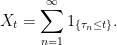
 has a Poisson distribution independently of
  , for all times
  , and for which the gaps
  between the stopping times are independent exponentially distributed random variables. As we will see, although Poisson processes are just one specific example, every quasi-left-continuous counting process can actually be reduced to the case of a Poisson process by a time change. As always, we work with respect to a
  is a
is a  , then the compensated Poisson process
  is a martingale. So, the compensator of X is the continuous process
  . More generally, X is said to be
  for all
  for a stopping time
  , in which case the compensator of X is just the same thing as
 ![{[X]_t=t}](https://s0.wp.com/latex.php?latex=%7B%5BX%5D_t%3Dt%7D&bg=ffffff&fg=000000&s=0&c=20201002) . Similarly, as we show below, a counting process is a homogeneous Poisson process of rate
. Similarly, as we show below, a counting process is a homogeneous Poisson process of rate ![{[X]_\infty}](https://s0.wp.com/latex.php?latex=%7B%5BX%5D_%5Cinfty%7D&bg=ffffff&fg=000000&s=0&c=20201002) is finite. Similarly, a counting process X has finite value
is finite. Similarly, a counting process X has finite value  at infinity if and only if the same is true of its compensator. Another property of a continuous local martingale X is that it is
  .
.  is a local martingale. Compensators of stopping times are sufficiently special that we can give an accurate description of how they behave. For example, if
  . If, on the other hand,
 are disjoint stopping times such that the union
 ![{\bigcup_n[\tau_n]}](https://s0.wp.com/latex.php?latex=%7B%5Cbigcup_n%5B%5Ctau_n%5D%7D&bg=ffffff&fg=000000&s=0&c=20201002) of their graphs contains all the jump times of X. That they are disjoint just means that
of their graphs contains all the jump times of X. That they are disjoint just means that  whenever
  , for any
  . As was shown in an earlier post, not only is such a sequence
  , on the right hand side of (
 plus the sum of the compensators of
  . The reduces compensators of locally integrable FV processes to those of processes consisting of a single jump at either a predictable or a totally inaccessible time.
  is a stochastic process adapted to the discrete-time filtered probability space
  . If X is integrable, then it is possible to decompose it into the sum of a martingale M and a process A, starting from zero, and such that
  . That is, A is a predictable process. The martingale condition on M enforces the identity
 ![\displaystyle A_n-A_{n-1}={\mathbb E}[A_n-A_{n-1}\vert\mathcal{F}_{n-1}]={\mathbb E}[X_n-X_{n-1}\vert\mathcal{F}_{n-1}].](https://s0.wp.com/latex.php?latex=%5Cdisplaystyle++A_n-A_%7Bn-1%7D%3D%7B%5Cmathbb+E%7D%5BA_n-A_%7Bn-1%7D%5Cvert%5Cmathcal%7BF%7D_%7Bn-1%7D%5D%3D%7B%5Cmathbb+E%7D%5BX_n-X_%7Bn-1%7D%5Cvert%5Cmathcal%7BF%7D_%7Bn-1%7D%5D.+&bg=ffffff&fg=000000&s=0&c=20201002)
![\displaystyle A_n=\sum_{k=1}^n{\mathbb E}\left[X_k-X_{k-1}\vert\mathcal{F}_{k-1}\right],](https://s0.wp.com/latex.php?latex=%5Cdisplaystyle++A_n%3D%5Csum_%7Bk%3D1%7D%5En%7B%5Cmathbb+E%7D%5Cleft%5BX_k-X_%7Bk-1%7D%5Cvert%5Cmathcal%7BF%7D_%7Bk-1%7D%5Cright%5D%2C+&bg=ffffff&fg=000000&s=0&c=20201002)
 is a martingale. So, X has compensator
  .
.
 of a cadlag process are
  separately for the cases where
  of a process is defined to be zero at time
  .
.
 if
if ![{\Delta A_\tau={\mathbb E}\left[\Delta X_\tau\vert\mathcal{F}_{\tau-}\right]}](https://s0.wp.com/latex.php?latex=%7B%5CDelta+A_%5Ctau%3D%7B%5Cmathbb+E%7D%5Cleft%5B%5CDelta+X_%5Ctau%5Cvert%5Cmathcal%7BF%7D_%7B%5Ctau-%7D%5Cright%5D%7D&bg=ffffff&fg=000000&s=0&c=20201002) if
if  Almost Sure