Special classes of processes, such as martingales, are very important to the study of stochastic calculus. In many cases, however, processes under consideration `almost’ satisfy the martingale property, but are not actually martingales. This occurs, for example, when taking limits or stochastic integrals with respect to martingales. It is necessary to generalize the martingale concept to that of local martingales. More generally, localization is a method of extending a given property to a larger class of processes. In this post I mention a few definitions and simple results concerning localization, and look more closely at local martingales in the next post.
Definition 1 Let P be a class of stochastic processes. Then, a process X is locally in P if there exists a sequence of stopping times
such that the stopped processes
are in P. The sequence
is called a localizing sequence for X (w.r.t. P).

I write 


Definition 2 A process is a
- a local martingale if it is locally in the class of cadlag martingales.
- a local submartingale if it is locally in the class of cadlag submartingales.
- a local supermartingale if it is locally in the class of cadlag supermartingales.
 is uniformly integrable. However, even if this is the case, it does not follow that the set of values of the process sampled at arbitrary stopping times is uniformly integrable.
 is any fixed time then this says that
 ![{X_\tau={\mathbb E}[X_t\mid\mathcal{F}_\tau]}](https://s0.wp.com/latex.php?latex=%7BX_%5Ctau%3D%7B%5Cmathbb+E%7D%5BX_t%5Cmid%5Cmathcal%7BF%7D_%5Ctau%5D%7D&bg=ffffff&fg=000000&s=0&c=20201002) for stopping times
for stopping times  . As sets of conditional expectations of a random variable are uniformly integrable, the following result holds.
 is uniformly integrable.
 is uniformly integrable.
 . The absolute maximum process of a martingale is denoted by
  . For any real number
  , the
, the  -norm of a random variable
  is
is![\displaystyle \Vert Z\Vert_p\equiv{\mathbb E}[|Z|^p]^{1/p}.](https://s0.wp.com/latex.php?latex=%5Cdisplaystyle++%5CVert+Z%5CVert_p%5Cequiv%7B%5Cmathbb+E%7D%5B%7CZ%7C%5Ep%5D%5E%7B1%2Fp%7D.+&bg=ffffff&fg=000000&s=0&c=20201002)
 -norm of its terminal value, and bound the
  .
. be a
be a  . Then
  ,
,
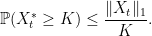
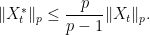
![\displaystyle \lVert X^*_t\rVert_1\le\frac e{e-1}{\mathbb E}\left[\lvert X_t\rvert \log\lvert X_t\rvert+1\right].](https://s0.wp.com/latex.php?latex=%5Cdisplaystyle++%5ClVert+X%5E%2A_t%5CrVert_1%5Cle%5Cfrac+e%7Be-1%7D%7B%5Cmathbb+E%7D%5Cleft%5B%5Clvert+X_t%5Crvert+%5Clog%5Clvert+X_t%5Crvert%2B1%5Cright%5D.+&bg=ffffff&fg=000000&s=0&c=20201002)
 is bounded above by some finite value as
  runs through the positive reals.
 exists and is finite, with probability one.
  , the argument is a relatively basic application of elementary integrals. For simple stopping times
  , the stochastic interval
 ![{(\sigma,\tau]}](https://s0.wp.com/latex.php?latex=%7B%28%5Csigma%2C%5Ctau%5D%7D&bg=ffffff&fg=000000&s=0&c=20201002) and its indicator function
and its indicator function ![{1_{(\sigma,\tau]}}](https://s0.wp.com/latex.php?latex=%7B1_%7B%28%5Csigma%2C%5Ctau%5D%7D%7D&bg=ffffff&fg=000000&s=0&c=20201002) are elementary predictable. For any submartingale
are elementary predictable. For any submartingale ![\displaystyle {\mathbb E}\left[X_\tau-X_\sigma\right]={\mathbb E}\left[\int_0^\infty 1_{(\sigma,\tau]}\,dX\right]\ge 0.](https://s0.wp.com/latex.php?latex=%5Cdisplaystyle++%7B%5Cmathbb+E%7D%5Cleft%5BX_%5Ctau-X_%5Csigma%5Cright%5D%3D%7B%5Cmathbb+E%7D%5Cleft%5B%5Cint_0%5E%5Cinfty+1_%7B%28%5Csigma%2C%5Ctau%5D%7D%5C%2CdX%5Cright%5D%5Cge+0.+&bg=ffffff&fg=000000&s=0&c=20201002)
 the following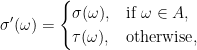
 by
by  extends inequality (
![\displaystyle {\mathbb E}\left[1_A(X_\tau-X_\sigma)\right]={\mathbb E}\left[X_\tau-X_{\sigma^\prime}\right]\ge 0.](https://s0.wp.com/latex.php?latex=%5Cdisplaystyle++%7B%5Cmathbb+E%7D%5Cleft%5B1_A%28X_%5Ctau-X_%5Csigma%29%5Cright%5D%3D%7B%5Cmathbb+E%7D%5Cleft%5BX_%5Ctau-X_%7B%5Csigma%5E%5Cprime%7D%5Cright%5D%5Cge+0.+&bg=ffffff&fg=000000&s=0&c=20201002)
 it implies the extension of the submartingale property
 ![{X_\sigma\le{\mathbb E}[X_\tau\vert\mathcal{F}_\sigma]}](https://s0.wp.com/latex.php?latex=%7BX_%5Csigma%5Cle%7B%5Cmathbb+E%7D%5BX_%5Ctau%5Cvert%5Cmathcal%7BF%7D_%5Csigma%5D%7D&bg=ffffff&fg=000000&s=0&c=20201002) to the random times. This argument applies to all simple stopping times, and is sufficient to prove the optional sampling result for discrete time submartingales. In continuous time, the additional hypothesis that the process is right-continuous is required. Then, the result follows by taking limits of simple stopping times.
to the random times. This argument applies to all simple stopping times, and is sufficient to prove the optional sampling result for discrete time submartingales. In continuous time, the additional hypothesis that the process is right-continuous is required. Then, the result follows by taking limits of simple stopping times. are integrable and the following are satisfied.
 ![{X_\sigma={\mathbb E}\left[X_{\tau}\vert\mathcal{F}_\sigma\right].}](https://s0.wp.com/latex.php?latex=%7BX_%5Csigma%3D%7B%5Cmathbb+E%7D%5Cleft%5BX_%7B%5Ctau%7D%5Cvert%5Cmathcal%7BF%7D_%5Csigma%5Cright%5D.%7D&bg=ffffff&fg=000000&s=0&c=20201002)
![{X_\sigma\le{\mathbb E}\left[X_{\tau}\vert\mathcal{F}_\sigma\right].}](https://s0.wp.com/latex.php?latex=%7BX_%5Csigma%5Cle%7B%5Cmathbb+E%7D%5Cleft%5BX_%7B%5Ctau%7D%5Cvert%5Cmathcal%7BF%7D_%5Csigma%5Cright%5D.%7D&bg=ffffff&fg=000000&s=0&c=20201002)
![{X_\sigma\ge{\mathbb E}\left[X_{\tau}\vert\mathcal{F}_\sigma\right].}](https://s0.wp.com/latex.php?latex=%7BX_%5Csigma%5Cge%7B%5Cmathbb+E%7D%5Cleft%5BX_%7B%5Ctau%7D%5Cvert%5Cmathcal%7BF%7D_%5Csigma%5Cright%5D.%7D&bg=ffffff&fg=000000&s=0&c=20201002)
 (and
(and  ). The jump at time
  .
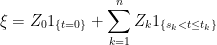
.
 ,
,  -measurable random variable
  and
and  -measurable random variables
  . Its integral with respect to a stochastic process
 which is a finite union of sets of the form
  for
for  and
and ![{(s,t]\times F}](https://s0.wp.com/latex.php?latex=%7B%28s%2Ct%5D%5Ctimes+F%7D&bg=ffffff&fg=000000&s=0&c=20201002) for nonnegative reals
for nonnegative reals  and
and  . Then, a process is an indicator function
  of some elementary predictable set
  if and only if it is elementary predictable and takes values in
  .
. ,
,
![\displaystyle \left\{{\mathbb E}\left[\int_0^t1_A\,dX\right]\colon A\textrm{ is elementary}\right\}](https://s0.wp.com/latex.php?latex=%5Cdisplaystyle++%5Cleft%5C%7B%7B%5Cmathbb+E%7D%5Cleft%5B%5Cint_0%5Et1_A%5C%2CdX%5Cright%5D%5Ccolon+A%5Ctextrm%7B+is+elementary%7D%5Cright%5C%7D+&bg=ffffff&fg=000000&s=0&c=20201002)


 whose time index
  . For real numbers
  , the number of upcrossings of
 ![{[a,b]}](https://s0.wp.com/latex.php?latex=%7B%5Ba%2Cb%5D%7D&bg=ffffff&fg=000000&s=0&c=20201002) is the supremum of the nonnegative integers
is the supremum of the nonnegative integers  such that there exists times
  satisfying
 . The number of upcrossings is denoted by
 ![{U[a,b]}](https://s0.wp.com/latex.php?latex=%7BU%5Ba%2Cb%5D%7D&bg=ffffff&fg=000000&s=0&c=20201002) , which is either a nonnegative integer or is infinite. Similarly, the number of downcrossings, denoted by
, which is either a nonnegative integer or is infinite. Similarly, the number of downcrossings, denoted by ![{D[a,b]}](https://s0.wp.com/latex.php?latex=%7BD%5Ba%2Cb%5D%7D&bg=ffffff&fg=000000&s=0&c=20201002) , is the supremum of the nonnegative integers
, is the supremum of the nonnegative integers  .
. converges to a limit in the extended real numbers if and only if the number of upcrossings
 ![{{\mathbb E}[\vert X_t\vert]<\infty}](https://s0.wp.com/latex.php?latex=%7B%7B%5Cmathbb+E%7D%5B%5Cvert+X_t%5Cvert%5D%3C%5Cinfty%7D&bg=ffffff&fg=000000&s=0&c=20201002) .
.![\displaystyle X_s={\mathbb E}[X_t\mid\mathcal{F}_s]](https://s0.wp.com/latex.php?latex=%5Cdisplaystyle++X_s%3D%7B%5Cmathbb+E%7D%5BX_t%5Cmid%5Cmathcal%7BF%7D_s%5D+&bg=ffffff&fg=000000&s=0&c=20201002)
 .
.  Almost Sure