Having covered the basics of continuous-time processes and filtrations in the previous posts, I now move on to stochastic integration. In standard calculus and ordinary differential equations, a central object of study is the derivative 


However, the kinds of processes studied in stochastic calculus are much less well behaved. For example, with probability one, the sample paths of standard Brownian motion are nowhere differentiable. Furthermore, they have infinite variation over bounded time intervals. Consequently, if 

Stochastic integration with respect to standard Brownian motion was developed by Kiyoshi Ito. This required restricting the class of possible integrands to be adapted processes, and the integral can then be constructed using the Ito isometry. This method was later extended to more general square integrable martingales and, then, to the class of semimartingales. It can then be shown that, as with Lebesgue integration, a version of the bounded and dominated convergence theorems are satisfied.
In these notes, a more direct approach is taken. The idea is that we simply define the stochastic integral such that the required elementary properties are satisfied. That is, it should agree with the explicit expressions for certain simple integrands, and should satisfy the bounded and dominated convergence theorems. Much of the theory of stochastic calculus follows directly from these properties, and detailed constructions of the integral are not required for many practical applications. Continue reading “The Stochastic Integral”
 of stopping times increasing to infinity such that the stopped processes
  are martingales. Local submartingales and local supermartingales are defined similarly.
 representing his net gain (or loss) just before the n’th toss. Let
  be a sequence of independent random variables with
  . Here,
  represents the outcome of the n’th toss, with 1 referring to a head and -1 referring to a tail. Set
  and
and

 . Letting
  then the optional stopping theorem shows that
  is a uniformly bounded martingale on
  , continuous at
  , and constant on
  . This is therefore a martingale, showing that
 ![{{\mathbb E}[X_1]=1\not={\mathbb E}[X_0]=0}](https://s0.wp.com/latex.php?latex=%7B%7B%5Cmathbb+E%7D%5BX_1%5D%3D1%5Cnot%3D%7B%5Cmathbb+E%7D%5BX_0%5D%3D0%7D&bg=ffffff&fg=000000&s=0&c=20201002) , so it is not a martingale.
, so it is not a martingale.  such that the stopped processes
 for the processes locally in P. Choosing the sequence
  of stopping times shows that
  . A class of processes is said to be stable if
  is in P whenever X is, for all stopping times
  . For example, the
  is uniformly integrable. However, even if this is the case, it does not follow that the set of values of the process sampled at arbitrary stopping times is uniformly integrable.
 is any fixed time then this says that
 ![{X_\tau={\mathbb E}[X_t\mid\mathcal{F}_\tau]}](https://s0.wp.com/latex.php?latex=%7BX_%5Ctau%3D%7B%5Cmathbb+E%7D%5BX_t%5Cmid%5Cmathcal%7BF%7D_%5Ctau%5D%7D&bg=ffffff&fg=000000&s=0&c=20201002) for stopping times
for stopping times  . As sets of conditional expectations of a random variable are uniformly integrable, the following result holds.
 is uniformly integrable.
 is uniformly integrable.
 converges uniformly on compacts to a limit
 ![{[0,t]}](https://s0.wp.com/latex.php?latex=%7B%5B0%2Ct%5D%7D&bg=ffffff&fg=000000&s=0&c=20201002) . That is,
. That is,
 .
. converges to the limit
 .
.  . The absolute maximum process of a martingale is denoted by
  . For any real number
  , the
, the  -norm of a random variable
  is
is![\displaystyle \Vert Z\Vert_p\equiv{\mathbb E}[|Z|^p]^{1/p}.](https://s0.wp.com/latex.php?latex=%5Cdisplaystyle++%5CVert+Z%5CVert_p%5Cequiv%7B%5Cmathbb+E%7D%5B%7CZ%7C%5Ep%5D%5E%7B1%2Fp%7D.+&bg=ffffff&fg=000000&s=0&c=20201002)
 -norm of its terminal value, and bound the
  .
. . Then
  ,
,
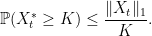
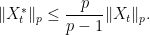
![\displaystyle \lVert X^*_t\rVert_1\le\frac e{e-1}{\mathbb E}\left[\lvert X_t\rvert \log\lvert X_t\rvert+1\right].](https://s0.wp.com/latex.php?latex=%5Cdisplaystyle++%5ClVert+X%5E%2A_t%5CrVert_1%5Cle%5Cfrac+e%7Be-1%7D%7B%5Cmathbb+E%7D%5Cleft%5B%5Clvert+X_t%5Crvert+%5Clog%5Clvert+X_t%5Crvert%2B1%5Cright%5D.+&bg=ffffff&fg=000000&s=0&c=20201002)
 is bounded above by some finite value as
  runs through the positive reals.
 exists and is finite, with probability one.
  , the argument is a relatively basic application of elementary integrals. For simple stopping times
  , the stochastic interval
 ![{(\sigma,\tau]}](https://s0.wp.com/latex.php?latex=%7B%28%5Csigma%2C%5Ctau%5D%7D&bg=ffffff&fg=000000&s=0&c=20201002) and its indicator function
and its indicator function ![{1_{(\sigma,\tau]}}](https://s0.wp.com/latex.php?latex=%7B1_%7B%28%5Csigma%2C%5Ctau%5D%7D%7D&bg=ffffff&fg=000000&s=0&c=20201002) are elementary predictable. For any submartingale
are elementary predictable. For any submartingale ![\displaystyle {\mathbb E}\left[X_\tau-X_\sigma\right]={\mathbb E}\left[\int_0^\infty 1_{(\sigma,\tau]}\,dX\right]\ge 0.](https://s0.wp.com/latex.php?latex=%5Cdisplaystyle++%7B%5Cmathbb+E%7D%5Cleft%5BX_%5Ctau-X_%5Csigma%5Cright%5D%3D%7B%5Cmathbb+E%7D%5Cleft%5B%5Cint_0%5E%5Cinfty+1_%7B%28%5Csigma%2C%5Ctau%5D%7D%5C%2CdX%5Cright%5D%5Cge+0.+&bg=ffffff&fg=000000&s=0&c=20201002)
 the following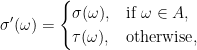
 by
by  extends inequality (
![\displaystyle {\mathbb E}\left[1_A(X_\tau-X_\sigma)\right]={\mathbb E}\left[X_\tau-X_{\sigma^\prime}\right]\ge 0.](https://s0.wp.com/latex.php?latex=%5Cdisplaystyle++%7B%5Cmathbb+E%7D%5Cleft%5B1_A%28X_%5Ctau-X_%5Csigma%29%5Cright%5D%3D%7B%5Cmathbb+E%7D%5Cleft%5BX_%5Ctau-X_%7B%5Csigma%5E%5Cprime%7D%5Cright%5D%5Cge+0.+&bg=ffffff&fg=000000&s=0&c=20201002)
 it implies the extension of the submartingale property
 ![{X_\sigma\le{\mathbb E}[X_\tau\vert\mathcal{F}_\sigma]}](https://s0.wp.com/latex.php?latex=%7BX_%5Csigma%5Cle%7B%5Cmathbb+E%7D%5BX_%5Ctau%5Cvert%5Cmathcal%7BF%7D_%5Csigma%5D%7D&bg=ffffff&fg=000000&s=0&c=20201002) to the random times. This argument applies to all simple stopping times, and is sufficient to prove the optional sampling result for discrete time submartingales. In continuous time, the additional hypothesis that the process is right-continuous is required. Then, the result follows by taking limits of simple stopping times.
to the random times. This argument applies to all simple stopping times, and is sufficient to prove the optional sampling result for discrete time submartingales. In continuous time, the additional hypothesis that the process is right-continuous is required. Then, the result follows by taking limits of simple stopping times. are integrable and the following are satisfied.
 ![{X_\sigma={\mathbb E}\left[X_{\tau}\vert\mathcal{F}_\sigma\right].}](https://s0.wp.com/latex.php?latex=%7BX_%5Csigma%3D%7B%5Cmathbb+E%7D%5Cleft%5BX_%7B%5Ctau%7D%5Cvert%5Cmathcal%7BF%7D_%5Csigma%5Cright%5D.%7D&bg=ffffff&fg=000000&s=0&c=20201002)
![{X_\sigma\le{\mathbb E}\left[X_{\tau}\vert\mathcal{F}_\sigma\right].}](https://s0.wp.com/latex.php?latex=%7BX_%5Csigma%5Cle%7B%5Cmathbb+E%7D%5Cleft%5BX_%7B%5Ctau%7D%5Cvert%5Cmathcal%7BF%7D_%5Csigma%5Cright%5D.%7D&bg=ffffff&fg=000000&s=0&c=20201002)
![{X_\sigma\ge{\mathbb E}\left[X_{\tau}\vert\mathcal{F}_\sigma\right].}](https://s0.wp.com/latex.php?latex=%7BX_%5Csigma%5Cge%7B%5Cmathbb+E%7D%5Cleft%5BX_%7B%5Ctau%7D%5Cvert%5Cmathcal%7BF%7D_%5Csigma%5Cright%5D.%7D&bg=ffffff&fg=000000&s=0&c=20201002)
 (and
(and  ). The jump at time
  .
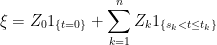
.
 ,
,  -measurable random variable
  and
and  -measurable random variables
  . Its integral with respect to a stochastic process
 which is a finite union of sets of the form
  for
for  and
and ![{(s,t]\times F}](https://s0.wp.com/latex.php?latex=%7B%28s%2Ct%5D%5Ctimes+F%7D&bg=ffffff&fg=000000&s=0&c=20201002) for nonnegative reals
for nonnegative reals  and
and  . Then, a process is an indicator function
  of some elementary predictable set
  if and only if it is elementary predictable and takes values in
  .
. ,
,
![\displaystyle \left\{{\mathbb E}\left[\int_0^t1_A\,dX\right]\colon A\textrm{ is elementary}\right\}](https://s0.wp.com/latex.php?latex=%5Cdisplaystyle++%5Cleft%5C%7B%7B%5Cmathbb+E%7D%5Cleft%5B%5Cint_0%5Et1_A%5C%2CdX%5Cright%5D%5Ccolon+A%5Ctextrm%7B+is+elementary%7D%5Cright%5C%7D+&bg=ffffff&fg=000000&s=0&c=20201002)


 whose time index
  . For real numbers
  , the number of upcrossings of
 ![{[a,b]}](https://s0.wp.com/latex.php?latex=%7B%5Ba%2Cb%5D%7D&bg=ffffff&fg=000000&s=0&c=20201002) is the supremum of the nonnegative integers
is the supremum of the nonnegative integers  such that there exists times
  satisfying
 . The number of upcrossings is denoted by
 ![{U[a,b]}](https://s0.wp.com/latex.php?latex=%7BU%5Ba%2Cb%5D%7D&bg=ffffff&fg=000000&s=0&c=20201002) , which is either a nonnegative integer or is infinite. Similarly, the number of downcrossings, denoted by
, which is either a nonnegative integer or is infinite. Similarly, the number of downcrossings, denoted by ![{D[a,b]}](https://s0.wp.com/latex.php?latex=%7BD%5Ba%2Cb%5D%7D&bg=ffffff&fg=000000&s=0&c=20201002) , is the supremum of the nonnegative integers
, is the supremum of the nonnegative integers  .
. converges to a limit in the extended real numbers if and only if the number of upcrossings
  Almost Sure