In this post we will describe precisely which processes can be realized as the jumps of a local martingale. This leads to very useful decomposition results for processes — see Theorem 10 below, where we give a decomposition of a process X into martingale and predictable components. As I will explore further in future posts, this enables us to construct particularly useful decompositions for local martingales and semimartingales.
Before going any further, we start by defining the class of local martingales which will be used to match prescribed jump processes. The purely discontinuous local martingales are, in a sense, the orthogonal complement to the class of continuous local martingales.
Definition 1 A local martingale X is said to be purely discontinuous iff XM is a local martingale for all continuous local martingales M.
The class of purely discontinuous local martingales is often denoted as 
Lemma 2 Every FV local martingale is purely discontinuous.
Proof: If X is an FV local martingale and M is a continuous local martingale then we can compute the quadratic covariation,
![\displaystyle [X,M]_t=\sum_{s\le t}\Delta X_s\Delta M_s=0.](https://s0.wp.com/latex.php?latex=%5Cdisplaystyle++%5BX%2CM%5D_t%3D%5Csum_%7Bs%5Cle+t%7D%5CDelta+X_s%5CDelta+M_s%3D0.+&bg=ffffff&fg=000000&s=0&c=20201002)
The first equality follows because X is an FV process, and the second because M is continuous. So, ![{XM=XM-[X,M]}](https://s0.wp.com/latex.php?latex=%7BXM%3DXM-%5BX%2CM%5D%7D&bg=ffffff&fg=000000&s=0&c=20201002)
Next, an important property of purely discontinuous local martingales is that they are determined uniquely by their jumps. Throughout these notes, I am considering two processes to be equal whenever they are equal up to evanescence.
Lemma 3 Purely discontinuous local martingales are uniquely determined by their initial value and jumps. That is, if X and Y are purely discontinuous local martingales with
and
, then
.
Proof: Setting 



![\displaystyle {\mathbb E}[M_t^2]\le{\mathbb E}[M_0^2]=0.](https://s0.wp.com/latex.php?latex=%5Cdisplaystyle++%7B%5Cmathbb+E%7D%5BM_t%5E2%5D%5Cle%7B%5Cmathbb+E%7D%5BM_0%5E2%5D%3D0.+&bg=ffffff&fg=000000&s=0&c=20201002)
So 

Note that if X is a continuous local martingale, then the constant process 
Corollary 4 Any local martingale which is both continuous and purely discontinuous is almost surely constant.
Recalling that the jump process, 
Theorem 5 Let H be a thin process. Then,
for a local martingale X if and only if
is locally integrable.
(a.s.) for all predictable stopping times
.
Furthermore, X can be chosen to be purely discontinuous with
, in which case it is unique.
Continue reading “Constructing Martingales with Prescribed Jumps”
 is an integrable discrete-time process
  , then the Doob decomposition expresses X as
 ![\displaystyle \setlength\arraycolsep{2pt} \begin{array}{rl} \displaystyle X_n&\displaystyle=M_n+A_n,\smallskip\\ \displaystyle A_n&\displaystyle=\sum_{k=1}^n{\mathbb E}\left[X_k-X_{k-1}\;\vert\mathcal{F}_{k-1}\right]. \end{array}](https://s0.wp.com/latex.php?latex=%5Cdisplaystyle++%5Csetlength%5Carraycolsep%7B2pt%7D+%5Cbegin%7Barray%7D%7Brl%7D+%5Cdisplaystyle+X_n%26%5Cdisplaystyle%3DM_n%2BA_n%2C%5Csmallskip%5C%5C+%5Cdisplaystyle+A_n%26%5Cdisplaystyle%3D%5Csum_%7Bk%3D1%7D%5En%7B%5Cmathbb+E%7D%5Cleft%5BX_k-X_%7Bk-1%7D%5C%3B%5Cvert%5Cmathcal%7BF%7D_%7Bk-1%7D%5Cright%5D.+%5Cend%7Barray%7D+&bg=ffffff&fg=000000&s=0&c=20201002)
 is
is  -measurable for each
  . The expected value of the variation of A can be computed in terms of X,
 ![\displaystyle {\mathbb E}\left[\sum_{k=1}^n\lvert A_k-A_{k-1}\rvert\right] ={\mathbb E}\left[\sum_{k=1}^n\left\lvert {\mathbb E}[X_k-X_{k-1}\vert\;\mathcal{F}_{k-1}]\right\rvert\right].](https://s0.wp.com/latex.php?latex=%5Cdisplaystyle++%7B%5Cmathbb+E%7D%5Cleft%5B%5Csum_%7Bk%3D1%7D%5En%5Clvert+A_k-A_%7Bk-1%7D%5Crvert%5Cright%5D+%3D%7B%5Cmathbb+E%7D%5Cleft%5B%5Csum_%7Bk%3D1%7D%5En%5Cleft%5Clvert+%7B%5Cmathbb+E%7D%5BX_k-X_%7Bk-1%7D%5Cvert%5C%3B%5Cmathcal%7BF%7D_%7Bk-1%7D%5D%5Cright%5Crvert%5Cright%5D.+&bg=ffffff&fg=000000&s=0&c=20201002)

 . Then, A has integrable variation over each finite time interval
 ![{[0,t]}](https://s0.wp.com/latex.php?latex=%7B%5B0%2Ct%5D%7D&bg=ffffff&fg=000000&s=0&c=20201002) satisfying
satisfying ![\displaystyle {\rm Var}_t(X)={\rm Var}_t(M)+{\mathbb E}\left[\int_0^t\,\vert dA\vert\right].](https://s0.wp.com/latex.php?latex=%5Cdisplaystyle++%7B%5Crm+Var%7D_t%28X%29%3D%7B%5Crm+Var%7D_t%28M%29%2B%7B%5Cmathbb+E%7D%5Cleft%5B%5Cint_0%5Et%5C%2C%5Cvert+dA%5Cvert%5Cright%5D.+&bg=ffffff&fg=000000&s=0&c=20201002)
![\displaystyle {\mathbb E}\left[\int_0^t\,\vert dA\vert\right]\le{\rm Var}_t(X).](https://s0.wp.com/latex.php?latex=%5Cdisplaystyle++%7B%5Cmathbb+E%7D%5Cleft%5B%5Cint_0%5Et%5C%2C%5Cvert+dA%5Cvert%5Cright%5D%5Cle%7B%5Crm+Var%7D_t%28X%29.+&bg=ffffff&fg=000000&s=0&c=20201002)
![{\bar{\mathbb R}_+=[0,\infty]}](https://s0.wp.com/latex.php?latex=%7B%5Cbar%7B%5Cmathbb+R%7D_%2B%3D%5B0%2C%5Cinfty%5D%7D&bg=ffffff&fg=000000&s=0&c=20201002) . Stopping a process can only decrease its mean variation (recall the alternative definitions
. Stopping a process can only decrease its mean variation (recall the alternative definitions 

 , so in this case the following result says that stopped martingales are martingales.



 . It is not required that the filtration satisfies either of the
 ![\displaystyle {\rm Var}_t(X)=\sup{\mathbb E}\left[\int_0^t\xi\,dX\right],](https://s0.wp.com/latex.php?latex=%5Cdisplaystyle++%7B%5Crm+Var%7D_t%28X%29%3D%5Csup%7B%5Cmathbb+E%7D%5Cleft%5B%5Cint_0%5Et%5Cxi%5C%2CdX%5Cright%5D%2C+&bg=ffffff&fg=000000&s=0&c=20201002)
 with
with  . Then, X is a quasimartingale if and only if
  is finite for all positive reals t. It was shown that all
 ![\displaystyle {\rm Var}_t(X)={\mathbb E}\left[X_0-X_t\right].](https://s0.wp.com/latex.php?latex=%5Cdisplaystyle++%7B%5Crm+Var%7D_t%28X%29%3D%7B%5Cmathbb+E%7D%5Cleft%5BX_0-X_t%5Cright%5D.+&bg=ffffff&fg=000000&s=0&c=20201002)
 with finite variation on bounded intervals can be decomposed as the difference of increasing functions or, equivalently, of decreasing functions. Replacing finite variation functions by quasimartingales and decreasing functions by supermartingales gives the following.

 is any other such decomposition then
  is a supermartingale.
 ![\displaystyle {\rm Var}_t(X)\le{\mathbb E}[Y_0-Y_t]+{\mathbb E}[Z_0-Z_t],](https://s0.wp.com/latex.php?latex=%5Cdisplaystyle++%7B%5Crm+Var%7D_t%28X%29%5Cle%7B%5Cmathbb+E%7D%5BY_0-Y_t%5D%2B%7B%5Cmathbb+E%7D%5BZ_0-Z_t%5D%2C+&bg=ffffff&fg=000000&s=0&c=20201002)
 if and only if the decomposition is minimal.
  are two such minimal decompositions, then
 ![\displaystyle {\rm Var}_t(X)=\sup{\mathbb E}\left[\sum_{k=1}^n\left\vert{\mathbb E}\left[X_{t_k}-X_{t_{k-1}}\;\vert\mathcal{F}_{t_{k-1}}\right]\right\vert\right].](https://s0.wp.com/latex.php?latex=%5Cdisplaystyle++%7B%5Crm+Var%7D_t%28X%29%3D%5Csup%7B%5Cmathbb+E%7D%5Cleft%5B%5Csum_%7Bk%3D1%7D%5En%5Cleft%5Cvert%7B%5Cmathbb+E%7D%5Cleft%5BX_%7Bt_k%7D-X_%7Bt_%7Bk-1%7D%7D%5C%3B%5Cvert%5Cmathcal%7BF%7D_%7Bt_%7Bk-1%7D%7D%5Cright%5D%5Cright%5Cvert%5Cright%5D.+&bg=ffffff&fg=000000&s=0&c=20201002)

 .
.  is a submartingale, so the Doob-Meyer decomposition guarantees the existence of an increasing predictable process
  such that
  is a local martingale. The term
 ![{{\mathbb E}[X_n-X_{n-1}\vert\mathcal{F}_{n-1}]\ge0}](https://s0.wp.com/latex.php?latex=%7B%7B%5Cmathbb+E%7D%5BX_n-X_%7Bn-1%7D%5Cvert%5Cmathcal%7BF%7D_%7Bn-1%7D%5D%5Cge0%7D&bg=ffffff&fg=000000&s=0&c=20201002) or, equivalently, if A is almost surely increasing.
or, equivalently, if A is almost surely increasing.

![\displaystyle {\mathbb E}[A_\tau]\le{\mathbb E}[X_\tau-X_0]](https://s0.wp.com/latex.php?latex=%5Cdisplaystyle++%7B%5Cmathbb+E%7D%5BA_%5Ctau%5D%5Cle%7B%5Cmathbb+E%7D%5BX_%5Ctau-X_0%5D+&bg=ffffff&fg=000000&s=0&c=20201002)
![\displaystyle {\mathbb E}[A_\tau]={\mathbb E}[X_\tau-X_0]](https://s0.wp.com/latex.php?latex=%5Cdisplaystyle++%7B%5Cmathbb+E%7D%5BA_%5Ctau%5D%3D%7B%5Cmathbb+E%7D%5BX_%5Ctau-X_0%5D+&bg=ffffff&fg=000000&s=0&c=20201002)
 is integrable. Then,
  and
and  exist almost surely, and (
 be the first time at which
  , then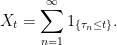
 has a Poisson distribution independently of
  , for all times
  , and for which the gaps
  between the stopping times are independent exponentially distributed random variables. As we will see, although Poisson processes are just one specific example, every quasi-left-continuous counting process can actually be reduced to the case of a Poisson process by a time change. As always, we work with respect to a
  is a
is a  , then the compensated Poisson process
  is a martingale. So, the compensator of X is the continuous process
  . More generally, X is said to be
  for all
  for a stopping time
  , in which case the compensator of X is just the same thing as
 ![{[X]_t=t}](https://s0.wp.com/latex.php?latex=%7B%5BX%5D_t%3Dt%7D&bg=ffffff&fg=000000&s=0&c=20201002) . Similarly, as we show below, a counting process is a homogeneous Poisson process of rate
. Similarly, as we show below, a counting process is a homogeneous Poisson process of rate ![{[X]_\infty}](https://s0.wp.com/latex.php?latex=%7B%5BX%5D_%5Cinfty%7D&bg=ffffff&fg=000000&s=0&c=20201002) is finite. Similarly, a counting process X has finite value
is finite. Similarly, a counting process X has finite value  at infinity if and only if the same is true of its compensator. Another property of a continuous local martingale X is that it is
  .
.  is a local martingale. Compensators of stopping times are sufficiently special that we can give an accurate description of how they behave. For example, if
  . If, on the other hand,
 are disjoint stopping times such that the union
 ![{\bigcup_n[\tau_n]}](https://s0.wp.com/latex.php?latex=%7B%5Cbigcup_n%5B%5Ctau_n%5D%7D&bg=ffffff&fg=000000&s=0&c=20201002) of their graphs contains all the jump times of X. That they are disjoint just means that
of their graphs contains all the jump times of X. That they are disjoint just means that  whenever
  , for any
  . As was shown in an earlier post, not only is such a sequence
  , on the right hand side of (
 plus the sum of the compensators of
  . The reduces compensators of locally integrable FV processes to those of processes consisting of a single jump at either a predictable or a totally inaccessible time.
  is a stochastic process adapted to the discrete-time filtered probability space
  . If X is integrable, then it is possible to decompose it into the sum of a martingale M and a process A, starting from zero, and such that
  . That is, A is a predictable process. The martingale condition on M enforces the identity
 ![\displaystyle A_n-A_{n-1}={\mathbb E}[A_n-A_{n-1}\vert\mathcal{F}_{n-1}]={\mathbb E}[X_n-X_{n-1}\vert\mathcal{F}_{n-1}].](https://s0.wp.com/latex.php?latex=%5Cdisplaystyle++A_n-A_%7Bn-1%7D%3D%7B%5Cmathbb+E%7D%5BA_n-A_%7Bn-1%7D%5Cvert%5Cmathcal%7BF%7D_%7Bn-1%7D%5D%3D%7B%5Cmathbb+E%7D%5BX_n-X_%7Bn-1%7D%5Cvert%5Cmathcal%7BF%7D_%7Bn-1%7D%5D.+&bg=ffffff&fg=000000&s=0&c=20201002)
![\displaystyle A_n=\sum_{k=1}^n{\mathbb E}\left[X_k-X_{k-1}\vert\mathcal{F}_{k-1}\right],](https://s0.wp.com/latex.php?latex=%5Cdisplaystyle++A_n%3D%5Csum_%7Bk%3D1%7D%5En%7B%5Cmathbb+E%7D%5Cleft%5BX_k-X_%7Bk-1%7D%5Cvert%5Cmathcal%7BF%7D_%7Bk-1%7D%5Cright%5D%2C+&bg=ffffff&fg=000000&s=0&c=20201002)
 is a martingale. So, X has compensator
  .
.
 of a cadlag process are
  separately for the cases where
  of a process is defined to be zero at time
  .
.
 if
if ![{\Delta A_\tau={\mathbb E}\left[\Delta X_\tau\vert\mathcal{F}_{\tau-}\right]}](https://s0.wp.com/latex.php?latex=%7B%5CDelta+A_%5Ctau%3D%7B%5Cmathbb+E%7D%5Cleft%5B%5CDelta+X_%5Ctau%5Cvert%5Cmathcal%7BF%7D_%7B%5Ctau-%7D%5Cright%5D%7D&bg=ffffff&fg=000000&s=0&c=20201002) if
if  then we write
  . Here, M is a martingale, so that
 ![{M_{n-1}={\mathbb E}[M_n\vert\mathcal{F}_{n-1}]}](https://s0.wp.com/latex.php?latex=%7BM_%7Bn-1%7D%3D%7B%5Cmathbb+E%7D%5BM_n%5Cvert%5Cmathcal%7BF%7D_%7Bn-1%7D%5D%7D&bg=ffffff&fg=000000&s=0&c=20201002) , and A is predictable with
, and A is predictable with ![\displaystyle \setlength\arraycolsep{2pt} \begin{array}{rl} \displaystyle A_n&\displaystyle=\sum_{k=1}^n{\mathbb E}[X_k-X_{k-1}\vert\mathcal{F}_{k-1}],\smallskip\\ \displaystyle M_n&\displaystyle=X_n-A_n. \end{array}](https://s0.wp.com/latex.php?latex=%5Cdisplaystyle++%5Csetlength%5Carraycolsep%7B2pt%7D+%5Cbegin%7Barray%7D%7Brl%7D+%5Cdisplaystyle+A_n%26%5Cdisplaystyle%3D%5Csum_%7Bk%3D1%7D%5En%7B%5Cmathbb+E%7D%5BX_k-X_%7Bk-1%7D%5Cvert%5Cmathcal%7BF%7D_%7Bk-1%7D%5D%2C%5Csmallskip%5C%5C+%5Cdisplaystyle+M_n%26%5Cdisplaystyle%3DX_n-A_n.+%5Cend%7Barray%7D+&bg=ffffff&fg=000000&s=0&c=20201002)
 Almost Sure