Probability and measure theory relies on the concept of measurable sets. On the real numbers ℝ, in particular, there are several different sigma-algebras which are commonly used, and a set is said to be measurable if it lies in the one under consideration. Probabilities and measures are only defined for events lying in a specific sigma-algebra, so it is essential to know if sets are measurable. Fortunately, most simply constructed events will indeed be measurable, but this is not always the case. In fact, once we start working with more complex setups, such as continuous-time stochastic processes observed at random times, non-measurable sets occur more commonly than might be expected. To avoid such issues, it is usual to enlarge the underlying sigma-algebra defining a probability space as much as possible.
The Borel sets form the smallest sigma-algebra containing the open sets or, equivalently, containing all intervals. This is denoted as  , which I will also shorten to
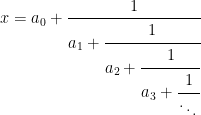
  . An explicit construction of a non-Borel set was given by Lusin in 1927. Every irrational real number can be expressed uniquely as a continued fraction
where a0 is an integer and ai are positive integers for i ≥ 1. Lusin considered the set of irrationals whose continued fraction coefficients contain a subsequence ak1, ak2, … such that each term is a divisor of the subsequent term.
Other examples can be given along similar lines to Lusin’s. Every real number has a binary expansion
where a0 is an integer and ai is in {0, 1} for each i ≥ 1. Consider the set of reals having a binary expansion for which there is an infinite sequence of positive integers k1, k2, …, each term strictly dividing the next, such that aki = 1. I will give proofs that these examples are non-Borel in this post.
There is a general method of enlarging sigma-algebras known as the completion. Consider a measure μ defined on a measurable space  consisting of sigma-algebra
  on set X. The completion
  consists of all subsets S ⊆ X which can be sandwiched between sets in whose difference has zero measure. That is, A ⊆ S ⊆ B for
  with μ(B ∖ A) = 0. It can be shown that is a sigma-algebra containing , and μ uniquely extends to a measure on this by taking μ(S) = μ(A) = μ(B) for S, A, B as above.
The Lebesgue measure λ is uniquely defined on the Borel sets by specifiying its value on intervals as λ((a, b)) = b – a. The completion  is the Lebesgue sigma-algebra, which I will denote by
  . Usually, when saying that a subset of the reals is measurable without further qualification, it is understood to mean that it is in . The non-Borel set constructed by Lusin can be shown to be measurable (in fact, its complement has zero Lebesgue measure).
While the Lebesgue measure extends uniquely to , this is not true for for all measures defined on the Borel sigma-algebra. In particular, it will not be true for singular measures, which assign a positive value to some Lebesgue-null sets. An example is the uniform probability measure (or, Haar measure) on the Cantor middle-thirds set C. This has zero Lebesgue measure, so every subset of C is in , but the uniform measure on C cannot be extended uniquely to all subsets. For this reason, universal completions are often used. For a measurable space , the universal completion  consists of the subsets of X which lie in the completion of with respect to every possible sigma-finite measure.
 |
The intersection is taken over all sigma-finite measures μ on . It is enough to take the intersection over finite or, even, probability measures, since every sigma-finite measure is equivalent to such. The universal completion is a bit tricky to understand in an explicit way but, by construction, all sigma-finite measures on a sigma-algebra extend uniquely to its universal completion. It can be shown that Lusin’s example of a non-Borel set does lie in the universal completion  .
.
Finally, the power set  consisting of all subsets of a set X is a sigma-algebra. For uncountable sets such as the reals, this is often too large to be of use and measures cannot be extended in any unique way. However, we have four common sigma-algebras of the real numbers,
 |
(1) |
In this post, I show that each of these inclusions is strict. That is, there are subsets of the reals which are not Lebesgue measurable, there are Lebesgue sets which are not in the universal completion , and there are sets in which are not Borel. Lusin’s construction is an example of the latter. The strictness of the other two inclusions does depend crucially on the axiom of choice so, unlike Lusin’s set, the examples demonstrating that these are strict are not explicit. Continue reading “Non-Measurable Sets” →

 , we denote the projection from
  by
by
 then, for every
  , there exists a
  such that
  . The measurable section theorem says that this choice can be made in a measurable way. That is, using
  then
then  and there is a measurable map
 to the whole of
  by setting
  outside of
  .
.
 . The graph of
 ![\displaystyle [\tau]=\left\{(\omega,\tau(\omega))\colon\tau(\omega)\in{\mathbb R}\right\}\subseteq\Omega\times{\mathbb R}.](https://s0.wp.com/latex.php?latex=%5Cdisplaystyle++%5B%5Ctau%5D%3D%5Cleft%5C%7B%28%5Comega%2C%5Ctau%28%5Comega%29%29%5Ccolon%5Ctau%28%5Comega%29%5Cin%7B%5Cmathbb+R%7D%5Cright%5C%7D%5Csubseteq%5COmega%5Ctimes%7B%5Cmathbb+R%7D.+&bg=ffffff&fg=000000&s=0&c=20201002)
 whenever
  can then be expressed by stating that
 ![{[\tau]\subseteq S}](https://s0.wp.com/latex.php?latex=%7B%5B%5Ctau%5D%5Csubseteq+S%7D&bg=ffffff&fg=000000&s=0&c=20201002) . This also ensures that
. This also ensures that  is a subset of
  .
. , the product paving
  denotes the collection of cartesian products
  for
for  and
and  , which is a paving on
  . The notation
  is used for the collection of countable intersections of a paving
 . It is not clear that
  is measurable, and we do not rely on this, although
  be a measurable space,
  be the collection of compact intervals in
  , and
, and  under finite unions.
 is measurable and its graph
 ![{[D(S)]}](https://s0.wp.com/latex.php?latex=%7B%5BD%28S%29%5D%7D&bg=ffffff&fg=000000&s=0&c=20201002) is contained in S.
is contained in S.  . The
. The  , of
, of  consists of the sets
  such that there exists
  with
with  and
and  . The probability space is complete if
  . More generally,
  on the sigma-algebra
  , where B and C are as above. Then
  is the completion of
  in
in  , and its measure is referred to as the outer measure of A. For any probability measure
  by approximating

 . We will be concerned primarily with the outer measure
  , and will show that that if A is the projection of some
  , then A can be approximated from below in the following sense: there exists
  in
in  . From this, it will follow that A is in the completion of
  which is increasing, continuous along increasing sequences, and continuous along decreasing sequences in
  then
then  .
. is increasing in n then
  as
as  .
. is decreasing in n then
  as
as  for all
  .
. .
. Almost Sure