A random variable has the standard n-dimensional normal distribution if its components are independent normal with zero mean and unit variance. A well known fact of such distributions is that they are invariant under rotations, which has the following consequence. The distribution of is invariant under rotations of and, hence, is fully determined by the values of and . This is known as the noncentral chi-square distribution with n degrees of freedom and noncentrality parameter , and denoted by . The moment generating function can be computed,
(1)
which holds for all with real part bounded above by 1/2.
A consequence of this is that the norm of an n-dimensional Brownian motionB is Markov. More precisely, letting be its natural filtration, then has the following property. For times , conditional on , is distributed as . This is known as the `n-dimensional’ squared Bessel process, and denoted by .
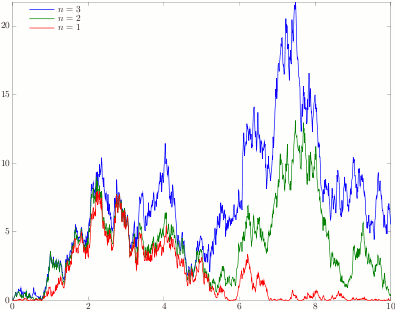
Figure 1: Squared Bessel processes of dimensions n=1,2,3
Alternatively, the process X can be described by a stochastic differential equation (SDE). Applying integration by parts,
(2)
As the standard Brownian motions have quadratic variation, the final term on the right-hand-side is equal to . Also, the covarations are zero for from which it can be seen that
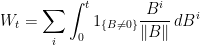
is a continuous local martingale with . By Lévy’s characterization, W is a Brownian motion and, substituting this back into (2), the squared Bessel process X solves the SDE
(3)
The standard existence and uniqueness results for stochastic differential equations do not apply here, since is not Lipschitz continuous. It is known that (3) does in fact have a unique solution, by the Yamada-Watanabe uniqueness theorem for 1-dimensional SDEs. However, I do not need and will not make use of this fact here. Actually, uniqueness in law follows from the explicit computation of the moment generating function in Theorem 5 below.
Although it is nonsensical to talk of an n-dimensional Brownian motion for non-integer n, Bessel processes can be extended to any real . This can be done either by specifying its distributions in terms of chi-square distributions or by the SDE (3). In this post I take the first approach, and then show that they are equivalent. Such processes appear in many situations in the theory of stochastic processes, and not just as the norm of Brownian motion. It also provides one of the relatively few interesting examples of stochastic differential equations whose distributions can be explicitly computed.
The distribution generalizes to all real , and can be defined as the unique distribution on with moment generating function given by equation (1). If and are independent, then has moment generating function and, therefore, has the distribution. That such distributions do indeed exist can be seen by constructing them. The distribution is a special case of the Gamma distribution and has probability density proportional to . If is a sequence of independent random variables with the standard normal distribution and T independently has the Poisson distribution of rate , then , which can be seen by computing its moment generating function. Adding an independent random variable Y to this produces the variable .
The definition of squared Bessel processes of any real dimension is as follows. We work with respect to a filtered probability space.
Definition 1 A process X is a squared Bessel process of dimension if it is continuous, adapted and, for any , conditional on , has the distribution.








![\displaystyle M_Z(\lambda)\equiv{\mathbb E}\left[e^{\lambda Z}\right]=\left(1-2\lambda\right)^{-\frac{n}{2}}\exp\left(\frac{\lambda\mu}{1-2\lambda}\right),](https://s0.wp.com/latex.php?latex=%5Cdisplaystyle++M_Z%28%5Clambda%29%5Cequiv%7B%5Cmathbb+E%7D%5Cleft%5Be%5E%7B%5Clambda+Z%7D%5Cright%5D%3D%5Cleft%281-2%5Clambda%5Cright%29%5E%7B-%5Cfrac%7Bn%7D%7B2%7D%7D%5Cexp%5Cleft%28%5Cfrac%7B%5Clambda%5Cmu%7D%7B1-2%5Clambda%7D%5Cright%29%2C+&bg=ffffff&fg=000000&s=0&c=20201002)





![\displaystyle dX = 2\sum_iB^i\,dB^i+\sum_id[B^i].](https://s0.wp.com/latex.php?latex=%5Cdisplaystyle++dX+%3D+2%5Csum_iB%5Ei%5C%2CdB%5Ei%2B%5Csum_id%5BB%5Ei%5D.+&bg=ffffff&fg=000000&s=0&c=20201002)
![{[B^i]_t=t}](https://s0.wp.com/latex.php?latex=%7B%5BB%5Ei%5D_t%3Dt%7D&bg=ffffff&fg=000000&s=0&c=20201002)

![{[B^i,B^j]}](https://s0.wp.com/latex.php?latex=%7B%5BB%5Ei%2CB%5Ej%5D%7D&bg=ffffff&fg=000000&s=0&c=20201002)

![{[W]_t=t}](https://s0.wp.com/latex.php?latex=%7B%5BW%5D_t%3Dt%7D&bg=ffffff&fg=000000&s=0&c=20201002)








distribution.
 Almost Sure