Recall from the previous post that a cadlag adapted process  is a local martingale if there is a sequence
  of stopping times increasing to infinity such that the stopped processes
  are martingales. Local submartingales and local supermartingales are defined similarly.
An example of a local martingale which is not a martingale is given by the `double-loss’ gambling strategy. Interestingly, in 18th century France, such strategies were known as martingales and is the origin of the mathematical term. Suppose that a gambler is betting sums of money, with even odds, on a simple win/lose game. For example, betting that a coin toss comes up heads. He could bet one dollar on the first toss and, if he loses, double his stake to two dollars for the second toss. If he loses again, then he is down three dollars and doubles the stake again to four dollars. If he keeps on doubling the stake after each loss in this way, then he is always gambling one more dollar than the total losses so far. He only needs to continue in this way until the coin eventually does come up heads, and he walks away with net winnings of one dollar. This therefore describes a fair game where, eventually, the gambler is guaranteed to win.
Of course, this is not an effective strategy in practise. The losses grow exponentially and, if he doesn’t win quickly, the gambler must hit his credit limit in which case he loses everything. All that the strategy achieves is to trade a large probability of winning a dollar against a small chance of losing everything. It does, however, give a simple example of a local martingale which is not a martingale.
The gamblers winnings can be defined by a stochastic process  representing his net gain (or loss) just before the n’th toss. Let
  be a sequence of independent random variables with
  . Here,
  represents the outcome of the n’th toss, with 1 referring to a head and -1 referring to a tail. Set
  and
and

This is a martingale with respect to its natural filtration, starting at zero and, eventually, ending up equal to one. It can be converted into a local martingale by speeding up the time scale to fit infinitely many tosses into a unit time interval

This is a martingale with respect to its natural filtration on the time interval  . Letting
  then the optional stopping theorem shows that
  is a uniformly bounded martingale on
  , continuous at
  , and constant on
  . This is therefore a martingale, showing that is a local martingale. However,
 ![{{\mathbb E}[X_1]=1\not={\mathbb E}[X_0]=0}](https://s0.wp.com/latex.php?latex=%7B%7B%5Cmathbb+E%7D%5BX_1%5D%3D1%5Cnot%3D%7B%5Cmathbb+E%7D%5BX_0%5D%3D0%7D&bg=ffffff&fg=000000&s=0&c=20201002) , so it is not a martingale. Continue reading “Local Martingales” →
, so it is not a martingale. Continue reading “Local Martingales” →

![\displaystyle f(X) = f(X_0)+\int f^\prime(X)\,dX + \frac{1}{2}\int f^{\prime\prime}(X)\,d[X].](https://s0.wp.com/latex.php?latex=%5Cdisplaystyle++f%28X%29+%3D+f%28X_0%29%2B%5Cint+f%5E%5Cprime%28X%29%5C%2CdX+%2B+%5Cfrac%7B1%7D%7B2%7D%5Cint+f%5E%7B%5Cprime%5Cprime%7D%28X%29%5C%2Cd%5BX%5D.+&bg=ffffff&fg=000000&s=0&c=20201002)


![\displaystyle \setlength\arraycolsep{2pt} \begin{array}{rl} \displaystyle f(X_t) =&\displaystyle f(X_0)+\int_0^t f^\prime(X_-)\,dX + \frac{1}{2}\int_0^t f^{\prime\prime}(X_-)\,d[X]\smallskip\\ &\displaystyle +\sum_{s\le t}\left(\Delta f(X_s)-f^\prime(X_{s-})\Delta X_s-\frac{1}{2}f^{\prime\prime}(X_{s-})\Delta X_s^2\right). \end{array}](https://s0.wp.com/latex.php?latex=%5Cdisplaystyle++%5Csetlength%5Carraycolsep%7B2pt%7D+%5Cbegin%7Barray%7D%7Brl%7D+%5Cdisplaystyle+f%28X_t%29+%3D%26%5Cdisplaystyle+f%28X_0%29%2B%5Cint_0%5Et+f%5E%5Cprime%28X_-%29%5C%2CdX+%2B+%5Cfrac%7B1%7D%7B2%7D%5Cint_0%5Et+f%5E%7B%5Cprime%5Cprime%7D%28X_-%29%5C%2Cd%5BX%5D%5Csmallskip%5C%5C+%26%5Cdisplaystyle+%2B%5Csum_%7Bs%5Cle+t%7D%5Cleft%28%5CDelta+f%28X_s%29-f%5E%5Cprime%28X_%7Bs-%7D%29%5CDelta+X_s-%5Cfrac%7B1%7D%7B2%7Df%5E%7B%5Cprime%5Cprime%7D%28X_%7Bs-%7D%29%5CDelta+X_s%5E2%5Cright%29.+%5Cend%7Barray%7D+&bg=ffffff&fg=000000&s=0&c=20201002)
 satisfies
  . This is just the
 , where the quadratic term
 ![{dX^2\equiv d[X]}](https://s0.wp.com/latex.php?latex=%7BdX%5E2%5Cequiv+d%5BX%5D%7D&bg=ffffff&fg=000000&s=0&c=20201002) is the
is the  is said to be a semimartingale if each of its components,
  , are semimartingales. The first and second order partial derivatives of a function are denoted by
  and
and  , and I make use of the
  which occur twice in a single term are summed over. Then, the statement of Ito’s lemma is as follows.
 . Then, for any twice continuously differentiable function
  ,
,  is a semimartingale and,
 ![\displaystyle df(X) = D_if(X)\,dX^i + \frac{1}{2}D_{ij}f(X)\,d[X^i,X^j].](https://s0.wp.com/latex.php?latex=%5Cdisplaystyle++df%28X%29+%3D+D_if%28X%29%5C%2CdX%5Ei+%2B+%5Cfrac%7B1%7D%7B2%7DD_%7Bij%7Df%28X%29%5C%2Cd%5BX%5Ei%2CX%5Ej%5D.+&bg=ffffff&fg=000000&s=0&c=20201002)
![{[X,Y]}](https://s0.wp.com/latex.php?latex=%7B%5BX%2CY%5D%7D&bg=ffffff&fg=000000&s=0&c=20201002) is a cadlag adapted process, so that its jumps
is a cadlag adapted process, so that its jumps ![{\Delta [X,Y]_t\equiv [X,Y]_t-[X,Y]_{t-}}](https://s0.wp.com/latex.php?latex=%7B%5CDelta+%5BX%2CY%5D_t%5Cequiv+%5BX%2CY%5D_t-%5BX%2CY%5D_%7Bt-%7D%7D&bg=ffffff&fg=000000&s=0&c=20201002) are well defined.
are well defined. are semimartingales then
 ![\displaystyle \Delta [X,Y]=\Delta X\Delta Y.](https://s0.wp.com/latex.php?latex=%5Cdisplaystyle++%5CDelta+%5BX%2CY%5D%3D%5CDelta+X%5CDelta+Y.+&bg=ffffff&fg=000000&s=0&c=20201002)
![{\Delta [X]=\Delta X^2}](https://s0.wp.com/latex.php?latex=%7B%5CDelta+%5BX%5D%3D%5CDelta+X%5E2%7D&bg=ffffff&fg=000000&s=0&c=20201002) .
.  gives
gives![\displaystyle \Delta XY = X_{-}\Delta Y + Y_{-}\Delta X + \Delta [X,Y],](https://s0.wp.com/latex.php?latex=%5Cdisplaystyle++%5CDelta+XY+%3D+X_%7B-%7D%5CDelta+Y+%2B+Y_%7B-%7D%5CDelta+X+%2B+%5CDelta+%5BX%2CY%5D%2C+&bg=ffffff&fg=000000&s=0&c=20201002)
![\displaystyle \sum_{s\le t}\Delta X^2_s\le [X]_t<\infty.](https://s0.wp.com/latex.php?latex=%5Cdisplaystyle++%5Csum_%7Bs%5Cle+t%7D%5CDelta+X%5E2_s%5Cle+%5BX%5D_t%3C%5Cinfty.+&bg=ffffff&fg=000000&s=0&c=20201002)
![{[X]}](https://s0.wp.com/latex.php?latex=%7B%5BX%5D%7D&bg=ffffff&fg=000000&s=0&c=20201002) is increasing, the inequality
is increasing, the inequality ![{[X]_t\ge \sum_{s\le t}\Delta [X]_s}](https://s0.wp.com/latex.php?latex=%7B%5BX%5D_t%5Cge+%5Csum_%7Bs%5Cle+t%7D%5CDelta+%5BX%5D_s%7D&bg=ffffff&fg=000000&s=0&c=20201002) holds. Substituting in
holds. Substituting in ![{\Delta[X]=\Delta X^2}](https://s0.wp.com/latex.php?latex=%7B%5CDelta%5BX%5D%3D%5CDelta+X%5E2%7D&bg=ffffff&fg=000000&s=0&c=20201002) gives the result. ⬜
gives the result. ⬜ can be defined as the Lebesgue-Stieltjes integral on the sample paths, which is well defined for locally bounded measurable integrands and, when the integrand is predictable, agrees with the stochastic integral.
![\displaystyle [X,V]_t = \int_0^t \Delta X\,dV = \sum_{s\le t}\Delta X_s\Delta V_s.](https://s0.wp.com/latex.php?latex=%5Cdisplaystyle++%5BX%2CV%5D_t+%3D+%5Cint_0%5Et+%5CDelta+X%5C%2CdV+%3D+%5Csum_%7Bs%5Cle+t%7D%5CDelta+X_s%5CDelta+V_s.+&bg=ffffff&fg=000000&s=0&c=20201002)
![{[X,V]=0}](https://s0.wp.com/latex.php?latex=%7B%5BX%2CV%5D%3D0%7D&bg=ffffff&fg=000000&s=0&c=20201002) .
.  can be written as
  . The following identity is easily verified,
![{[0,t]}](https://s0.wp.com/latex.php?latex=%7B%5B0%2Ct%5D%7D&bg=ffffff&fg=000000&s=0&c=20201002) into
into  equal parts. That is, set
  for
for  . Then, using
  and summing equation (
 , and therefore is of order
  . This vanishes in the limit
  , leading to the integration by parts formula
 are normal random variables with standard deviation
  . It follows that the final term on the right hand side of (
 .
.  can be interpreted as a
  represents the Lebesgue-Stieltjes integral of
  with respect to the
  to be
to be 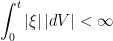
 . Then,
  and the stochastic integral
  agrees with the Lebesgue-Stieltjes integral, with probability one.
  is a sequence of predictable processes dominated by any such
  , so that
  for each
 of a function
  . This does, however, require restricting attention to differentiable functions. By integrating, it is possible to generalize to
  is continuous, then the
  is well defined. The Lebesgue-Stieltjes integral further generalizes this to measurable integrands.
 is not defined using standard methods.
 such that the stopped processes
 for the processes locally in P. Choosing the sequence
  of stopping times shows that
  . A class of processes is said to be stable if
  is in P whenever X is, for all stopping times
  . For example, the
  is uniformly integrable. However, even if this is the case, it does not follow that the set of values of the process sampled at arbitrary stopping times is uniformly integrable.
![{X_\tau={\mathbb E}[X_t\mid\mathcal{F}_\tau]}](https://s0.wp.com/latex.php?latex=%7BX_%5Ctau%3D%7B%5Cmathbb+E%7D%5BX_t%5Cmid%5Cmathcal%7BF%7D_%5Ctau%5D%7D&bg=ffffff&fg=000000&s=0&c=20201002) for stopping times
for stopping times  . As sets of conditional expectations of a random variable are uniformly integrable, the following result holds.
 is uniformly integrable.
 is uniformly integrable.
 Almost Sure