Quadratic Variations and Integration by Parts

A major difference between standard integral calculus and stochastic calculus is the existence of quadratic variations and covariations. Such terms show up, for example, in the stochastic version of the integration by parts formula.

For motivation, let us start by considering a standard argument for differentiable processes. The increment of a process {X} over a time step {\delta t>0} can be written as {\delta X_t\equiv X_{t+\delta t}-X_t}. The following identity is easily verified,

\displaystyle  \delta XY = X\delta Y + Y\delta X + \delta X \delta Y. (1)

Now, divide the time interval {[0,t]} into {n} equal parts. That is, set {t_k=kt/n} for {k=0,1,\ldots,n}. Then, using {\delta t=1/n} and summing equation (1) over these times,

\displaystyle  X_tY_t -X_0Y_0=\sum_{k=0}^{n-1} X_{t_k}\delta Y_{t_k} +\sum_{k=0}^{n-1}Y_{t_k}\delta X_{t_k}+\sum_{k=0}^{n-1}\delta X_{t_k}\delta Y_{t_k}. (2)

If the processes are continuously differentiable, then the final term on the right hand side is a sum of {n} terms, each of order {1/n^2}, and therefore is of order {1/n}. This vanishes in the limit {n\rightarrow\infty}, leading to the integration by parts formula

\displaystyle  X_tY_t-X_0Y_0 = \int_0^t X\,dY + \int_0^t Y\,dX.

Now, suppose that {X,Y} are standard Brownian motions. Then, {\delta X,\delta Y} are normal random variables with standard deviation {\sqrt{\delta t}}. It follows that the final term on the right hand side of (2) is a sum of {n} terms each of which is, on average, of order {1/n}. So, even in the limit as {n} goes to infinity, it does not vanish. Consequently, in stochastic calculus, the integration by parts formula requires an additional term, which is called the quadratic covariation (or, just covariation) of {X} and {Y}. Continue reading “Quadratic Variations and Integration by Parts”

Properties of the Stochastic Integral

In the previous two posts I gave a definition of stochastic integration. This was achieved via an explicit expression for elementary integrands, and extended to all bounded predictable integrands by bounded convergence in probability. The extension to unbounded integrands was done using dominated convergence in probability. Similarly, semimartingales were defined as those cadlag adapted processes for which such an integral exists.

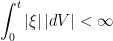
The current post will show how the basic properties of stochastic integration follow from this definition. First, if {V} is a cadlag process whose sample paths are almost surely of finite variation over an interval {[0,t]}, then {\int_0^t\xi\,dV} can be interpreted as a Lebesgue-Stieltjes integral on the sample paths. If the process is also adapted, then it will be a semimartingale and the stochastic integral can be used. Fortunately, these two definitions of integration do agree with each other. The term FV process is used to refer to such cadlag adapted processes which are almost surely of finite variation over all bounded time intervals. The notation {\int_0^t\vert\xi\vert\,\vert dV\vert} represents the Lebesgue-Stieltjes integral of {\vert\xi\vert} with respect to the variation of {V}. Then, the condition for {\xi} to be {V}-integrable in the Lebesgue-Stieltjes sense is precisely that this integral is finite.

Lemma 1 Every FV process {V} is a semimartingale. Furthermore, let {\xi} be a predictable process satisfying

\displaystyle  \int_0^t\vert\xi\vert\,\vert dV\vert<\infty (1)

almost surely, for each {t\ge 0}. Then, {\xi\in L^1(V)} and the stochastic integral {\int\xi\,dV} agrees with the Lebesgue-Stieltjes integral, with probability one.

Continue reading “Properties of the Stochastic Integral”

Extending the Stochastic Integral

In the previous post, I used the property of bounded convergence in probability to define stochastic integration for bounded predictable integrands. For most applications, this is rather too restrictive, and in this post the integral will be extended to unbounded integrands. As bounded convergence is not much use in this case, the dominated convergence theorem will be used instead.

The first thing to do is to define a class of integrable processes for which the integral with respect to {X} is well-defined. Suppose that {\xi^n} is a sequence of predictable processes dominated by any such {X}-integrable process {\alpha}, so that {\vert\xi^n\vert\le\vert\alpha\vert} for each {n}. If this sequence converges to a limit {\xi}, then dominated convergence in probability states that the integrals converge in probability,

\displaystyle  \int_0^t\xi^n\,dX\rightarrow\int_0^t\xi\,dX\ \ \text{(in probability)} (1)

as {n\rightarrow\infty}. Continue reading “Extending the Stochastic Integral”

The Stochastic Integral

Having covered the basics of continuous-time processes and filtrations in the previous posts, I now move on to stochastic integration. In standard calculus and ordinary differential equations, a central object of study is the derivative {df/dt} of a function {f(t)}. This does, however, require restricting attention to differentiable functions. By integrating, it is possible to generalize to bounded variation functions. If {f} is such a function and {g} is continuous, then the Riemann-Stieltjes integral {\int_0^tg\,df} is well defined. The Lebesgue-Stieltjes integral further generalizes this to measurable integrands.

However, the kinds of processes studied in stochastic calculus are much less well behaved. For example, with probability one, the sample paths of standard Brownian motion are nowhere differentiable. Furthermore, they have infinite variation over bounded time intervals. Consequently, if {X} is such a process, then the integral {\int_0^t\xi\,dX} is not defined using standard methods.

Stochastic integration with respect to standard Brownian motion was developed by Kiyoshi Ito. This required restricting the class of possible integrands to be adapted processes, and the integral can then be constructed using the Ito isometry. This method was later extended to more general square integrable martingales and, then, to the class of semimartingales. It can then be shown that, as with Lebesgue integration, a version of the bounded and dominated convergence theorems are satisfied.

In these notes, a more direct approach is taken. The idea is that we simply define the stochastic integral such that the required elementary properties are satisfied. That is, it should agree with the explicit expressions for certain simple integrands, and should satisfy the bounded and dominated convergence theorems. Much of the theory of stochastic calculus follows directly from these properties, and detailed constructions of the integral are not required for many practical applications. Continue reading “The Stochastic Integral”

Local Martingales

Recall from the previous post that a cadlag adapted process {X} is a local martingale if there is a sequence {\tau_n} of stopping times increasing to infinity such that the stopped processes {1_{\{\tau_n>0\}}X^{\tau_n}} are martingales. Local submartingales and local supermartingales are defined similarly.

An example of a local martingale which is not a martingale is given by the `double-loss’ gambling strategy. Interestingly, in 18th century France, such strategies were known as martingales and is the origin of the mathematical term. Suppose that a gambler is betting sums of money, with even odds, on a simple win/lose game. For example, betting that a coin toss comes up heads. He could bet one dollar on the first toss and, if he loses, double his stake to two dollars for the second toss. If he loses again, then he is down three dollars and doubles the stake again to four dollars. If he keeps on doubling the stake after each loss in this way, then he is always gambling one more dollar than the total losses so far. He only needs to continue in this way until the coin eventually does come up heads, and he walks away with net winnings of one dollar. This therefore describes a fair game where, eventually, the gambler is guaranteed to win.

Of course, this is not an effective strategy in practise. The losses grow exponentially and, if he doesn’t win quickly, the gambler must hit his credit limit in which case he loses everything. All that the strategy achieves is to trade a large probability of winning a dollar against a small chance of losing everything. It does, however, give a simple example of a local martingale which is not a martingale.

The gamblers winnings can be defined by a stochastic process {\{Z_n\}_{n=1,\ldots}} representing his net gain (or loss) just before the n’th toss. Let {\epsilon_1,\epsilon_2,\ldots} be a sequence of independent random variables with {{\mathbb P}(\epsilon_n=1)={\mathbb P}(\epsilon_n=-1)=1/2}. Here, {\epsilon_n} represents the outcome of the n’th toss, with 1 referring to a head and -1 referring to a tail. Set {Z_1=0} and

\displaystyle  Z_{n}=\begin{cases} 1,&\text{if }Z_{n-1}=1,\\ Z_{n-1}+\epsilon_n(1-Z_{n-1}),&\text{otherwise}. \end{cases}

This is a martingale with respect to its natural filtration, starting at zero and, eventually, ending up equal to one. It can be converted into a local martingale by speeding up the time scale to fit infinitely many tosses into a unit time interval

\displaystyle  X_t=\begin{cases} Z_n,&\text{if }1-1/n\le t<1-1/(n+1),\\ 1,&\text{if }t\ge 1. \end{cases}

This is a martingale with respect to its natural filtration on the time interval {[0,1)}. Letting {\tau_n=\inf\{t\colon\vert X_t\vert\ge n\}} then the optional stopping theorem shows that {X^{\tau_n}_t} is a uniformly bounded martingale on {t<1}, continuous at {t=1}, and constant on {t\ge 1}. This is therefore a martingale, showing that {X} is a local martingale. However, {{\mathbb E}[X_1]=1\not={\mathbb E}[X_0]=0}, so it is not a martingale. Continue reading “Local Martingales”

Localization

Special classes of processes, such as martingales, are very important to the study of stochastic calculus. In many cases, however, processes under consideration `almost’ satisfy the martingale property, but are not actually martingales. This occurs, for example, when taking limits or stochastic integrals with respect to martingales. It is necessary to generalize the martingale concept to that of local martingales. More generally, localization is a method of extending a given property to a larger class of processes. In this post I mention a few definitions and simple results concerning localization, and look more closely at local martingales in the next post.

Definition 1 Let P be a class of stochastic processes. Then, a process X is locally in P if there exists a sequence of stopping times {\tau_n\uparrow\infty} such that the stopped processes

\displaystyle  1_{\{\tau_n>0\}}X^{\tau_n}

are in P. The sequence {\tau_n} is called a localizing sequence for X (w.r.t. P).

I write {P_{\rm loc}} for the processes locally in P. Choosing the sequence {\tau_n\equiv\infty} of stopping times shows that {P\subseteq P_{\rm loc}}. A class of processes is said to be stable if {1_{\{\tau>0\}}X^\tau} is in P whenever X is, for all stopping times {\tau}. For example, the optional stopping theorem shows that the classes of cadlag martingales, cadlag submartingales and cadlag supermartingales are all stable.

Definition 2 A process is a

  1. a local martingale if it is locally in the class of cadlag martingales.
  2. a local submartingale if it is locally in the class of cadlag submartingales.
  3. a local supermartingale if it is locally in the class of cadlag supermartingales.

Continue reading “Localization”

Class (D) Processes

A stochastic process X is said to be uniformly integrable if the set of random variables {\{X_t\colon t\in{\mathbb R}_+\}} is uniformly integrable. However, even if this is the case, it does not follow that the set of values of the process sampled at arbitrary stopping times is uniformly integrable.

For the case of a cadlag martingale X, optional sampling can be used. If {t\ge 0} is any fixed time then this says that {X_\tau={\mathbb E}[X_t\mid\mathcal{F}_\tau]} for stopping times {\tau\le t}. As sets of conditional expectations of a random variable are uniformly integrable, the following result holds.

Lemma 1 Let X be a cadlag martingale. Then, for each {t\ge 0}, the set

\displaystyle  \{X_\tau\colon\tau\le t\text{\ is\ a\ stopping\ time}\}

is uniformly integrable.

This suggests the following generalized concepts of uniform integrability for stochastic processes.

Definition 2 Let X be a jointly measurable stochastic process. Then, it is

  • of class (D) if {\{X_\tau\colon\tau<\infty\text{ is a stopping time}\}} is uniformly integrable.
  • of class (DL) if, for each {t\ge 0}, {\{X_\tau\colon\tau\le t\text{ is a stopping time}\}} is uniformly integrable.

Continue reading “Class (D) Processes”

U.C.P. and Semimartingale Convergence

A mode of convergence on the space of processes which occurs often in the study of stochastic calculus, is that of uniform convergence on compacts in probability or ucp convergence for short.

First, a sequence of (non-random) functions {f_n\colon{\mathbb R}_+\rightarrow{\mathbb R}} converges uniformly on compacts to a limit {f} if it converges uniformly on each bounded interval {[0,t]}. That is,

\displaystyle  \sup_{s\le t}\vert f_n(s)-f(s)\vert\rightarrow 0 (1)

as {n\rightarrow\infty}.

If stochastic processes are used rather than deterministic functions, then convergence in probability can be used to arrive at the following definition.

Definition 1 A sequence of jointly measurable stochastic processes {X^n} converges to the limit {X} uniformly on compacts in probability if

\displaystyle  {\mathbb P}\left(\sup_{s\le t}\vert X^n_s-X_s\vert>K\right)\rightarrow 0

as {n\rightarrow\infty} for each {t,K>0}.

Continue reading “U.C.P. and Semimartingale Convergence”

Martingale Inequalities

Martingale inequalities are an important subject in the study of stochastic processes. The subject of this post is Doob’s inequalities which bound the distribution of the maximum value of a martingale in terms of its terminal distribution, and is a consequence of the optional sampling theorem. We work with respect to a filtered probability space {(\Omega,\mathcal{F},\{\mathcal{F}_t\}_{t\ge 0},{\mathbb P})}. The absolute maximum process of a martingale is denoted by {X^*_t\equiv\sup_{s\le t}\vert X_s\vert}. For any real number {p\ge 1}, the {L^p}-norm of a random variable {Z} is

\displaystyle  \Vert Z\Vert_p\equiv{\mathbb E}[|Z|^p]^{1/p}.

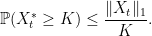
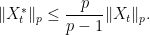
Then, Doob’s inequalities bound the distribution of the maximum of a martingale by the {L^1}-norm of its terminal value, and bound the {L^p}-norm of its maximum by the {L^p}-norm of its terminal value for all {p>1}.

Theorem 1 Let {X} be a cadlag martingale and {t>0}. Then

  1. for every {K>0},

    \displaystyle  {\mathbb P}(X^*_t\ge K)\le\frac{\lVert X_t\rVert_1}{K}.

  2. for every {p>1},

    \displaystyle  \lVert X^*_t\rVert_p\le \frac{p}{p-1}\Vert X_t\Vert_p.

  3. \displaystyle  \lVert X^*_t\rVert_1\le\frac e{e-1}{\mathbb E}\left[\lvert X_t\rvert \log\lvert X_t\rvert+1\right].

Continue reading “Martingale Inequalities”

Martingale Convergence

The martingale property is strong enough to ensure that, under relatively weak conditions, we are guaranteed convergence of the processes as time goes to infinity. In a previous post, I used Doob’s upcrossing inequality to show that, with probability one, discrete-time martingales will converge at infinity under the extra condition of {L^1}-boundedness. Here, I consider continuous-time martingales. This is a more general situation, because it considers limits as time runs through the uncountably infinite set of positive reals instead of the countable set of positive integer times. Although these results can also be proven in a similar way by counting the upcrossings of a process, I instead show how they follow directly from the existence of cadlag modifications. We work with respect to a complete filtered probability space {(\Omega,\mathcal{F},\{\mathcal{F}_t\}_{t\ge 0},{\mathbb P})}.

Recall that a stochastic process {X} is {L^1}-bounded if the set {\{X_t\colon t\in{\mathbb R}_+\}} is {L^1}-bounded. That is, {{\mathbb E}|X_t|} is bounded above by some finite value as {t} runs through the positive reals.

Theorem 1 Let {X} be a cadlag and {L^1}-bounded martingale (or submartingale, or supermartingale). Then, the limit {X_\infty=\lim_{t\rightarrow\infty}X_t} exists and is finite, with probability one.

Continue reading “Martingale Convergence”