Recall Doob’s inequalities, covered earlier in these notes, which bound expectations of functions of the maximum of a martingale in terms of its terminal distribution. Although these are often applied to martingales, they hold true more generally for cadlag submartingales. Here, I use  to denote the running maximum of a process.
Theorem 1 Let X be a nonnegative cadlag submartingale. Then,
In particular, for a cadlag martingale X, then  is a submartingale, so theorem 1 applies with in place of X.
We also saw the following much stronger (sub)martingale inequality in the post on the maximum maximum of martingales with known terminal distribution.
Theorem 2 Let X be a cadlag submartingale. Then, for any real K and nonnegative real t,
![\displaystyle {\mathbb P}(\bar X_t\ge K)\le\inf_{x < K}\frac{{\mathbb E}[(X_t-x)_+]}{K-x}.](https://s0.wp.com/latex.php?latex=%5Cdisplaystyle++%7B%5Cmathbb+P%7D%28%5Cbar+X_t%5Cge+K%29%5Cle%5Cinf_%7Bx+%3C+K%7D%5Cfrac%7B%7B%5Cmathbb+E%7D%5B%28X_t-x%29_%2B%5D%7D%7BK-x%7D.+&bg=ffffff&fg=000000&s=0&c=20201002) |
(1) |
This is particularly sharp, in the sense that for any distribution for  , there exists a martingale with this terminal distribution for which (1) becomes an equality simultaneously for all values of K. Furthermore, all of the inequalities stated in theorem 1 follow from (1). For example, the first one is obtained by taking
  in (1). The remaining two can also be proved from (1) by integrating over K.
Note that all of the submartingale inequalities above are of the form
![\displaystyle {\mathbb E}[F(\bar X_t)]\le{\mathbb E}[G(X_t)]](https://s0.wp.com/latex.php?latex=%5Cdisplaystyle++%7B%5Cmathbb+E%7D%5BF%28%5Cbar+X_t%29%5D%5Cle%7B%5Cmathbb+E%7D%5BG%28X_t%29%5D+&bg=ffffff&fg=000000&s=0&c=20201002) |
(2) |
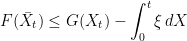
for certain choices of functions  . The aim of this post is to show how they have a more general `pathwise’ form,
 |
(3) |
for some nonnegative predictable process  . It is relatively straightforward to show that (2) follows from (3) by noting that the integral is a submartingale and, hence, has nonnegative expectation. To be rigorous, there are some integrability considerations to deal with, so a proof will be included later in this post.
Inequality (3) is required to hold almost everywhere, and not just in expectation, so is a considerably stronger statement than the standard martingale inequalities. Furthermore, it is not necessary for X to be a submartingale for (3) to make sense, as it holds for all semimartingales. We can go further, and even drop the requirement that X is a semimartingale. As we will see, in the examples covered in this post,  will be of the form
  for an increasing right-continuous function
  , so integration by parts can be used,
 |
(4) |
The right hand side of (4) is well-defined for any cadlag real-valued process, by using the pathwise Lebesgue–Stieltjes integral with respect to the increasing process  , so can be used as the definition of
  . In the case where X is a semimartingale, integration by parts ensures that this agrees with the stochastic integral
  . Since we now have an interpretation of (3) in a pathwise sense for all cadlag processes X, it is no longer required to suppose that X is a submartingale, a semimartingale, or even require the existence of an underlying probability space. All that is necessary is for
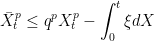
  to be a cadlag real-valued function. Hence, we reduce the martingale inequalities to straightforward results of real-analysis not requiring any probability theory and, consequently, are much more general. I state the precise pathwise generalizations of Doob’s inequalities now, leaving the proof until later in the post. As the first of inequality of theorem 1 is just the special case of (1) with , we do not need to explicitly include this here.
Theorem 3 Let X be a cadlag process and t be a nonnegative time.
- For real
 ,
,
 |
(5) |
where  .
.
- If X is nonnegative and p,q are positive reals with
 then,
then,
 |
(6) |
where  .
.
- If X is nonnegative then,
 |
(7) |
where  .
.
Continue reading “Pathwise Martingale Inequalities” →
![\displaystyle c_p^{-1}{\mathbb E}[[M]^{p/2}_\tau]\le{\mathbb E}[\bar M_\tau^p]\le C_p{\mathbb E}[[M]^{p/2}_\tau].](https://s0.wp.com/latex.php?latex=%5Cdisplaystyle++c_p%5E%7B-1%7D%7B%5Cmathbb+E%7D%5B%5BM%5D%5E%7Bp%2F2%7D_%5Ctau%5D%5Cle%7B%5Cmathbb+E%7D%5B%5Cbar+M_%5Ctau%5Ep%5D%5Cle+C_p%7B%5Cmathbb+E%7D%5B%5BM%5D%5E%7Bp%2F2%7D_%5Ctau%5D.+&bg=ffffff&fg=000000&s=0&c=20201002)

![{[M]}](https://s0.wp.com/latex.php?latex=%7B%5BM%5D%7D&bg=ffffff&fg=000000&s=0&c=20201002)


![{[M]_0=M_0^2}](https://s0.wp.com/latex.php?latex=%7B%5BM%5D_0%3DM_0%5E2%7D&bg=ffffff&fg=000000&s=0&c=20201002)

![\displaystyle c_p^{-1}[M]^{p/2}+\int\alpha dM\le\bar M^p\le C_p[M]^{p/2}+\int\beta dM](https://s0.wp.com/latex.php?latex=%5Cdisplaystyle++c_p%5E%7B-1%7D%5BM%5D%5E%7Bp%2F2%7D%2B%5Cint%5Calpha+dM%5Cle%5Cbar+M%5Ep%5Cle+C_p%5BM%5D%5E%7Bp%2F2%7D%2B%5Cint%5Cbeta+dM+&bg=ffffff&fg=000000&s=0&c=20201002)

for a local (sub)martingale N starting from zero. Then,
for all stopping times


![\displaystyle {\mathbb E}[1_{\{\tau_n\ge\tau\}}X_\tau]\le{\mathbb E}[X_{\tau_n\wedge\tau}]={\mathbb E}[Y_{\tau_n\wedge\tau}]-{\mathbb E}[N_{\tau_n\wedge\tau}]\le{\mathbb E}[Y_{\tau_n\wedge\tau}]\le{\mathbb E}[Y_\tau].](https://s0.wp.com/latex.php?latex=%5Cdisplaystyle++%7B%5Cmathbb+E%7D%5B1_%7B%5C%7B%5Ctau_n%5Cge%5Ctau%5C%7D%7DX_%5Ctau%5D%5Cle%7B%5Cmathbb+E%7D%5BX_%7B%5Ctau_n%5Cwedge%5Ctau%7D%5D%3D%7B%5Cmathbb+E%7D%5BY_%7B%5Ctau_n%5Cwedge%5Ctau%7D%5D-%7B%5Cmathbb+E%7D%5BN_%7B%5Ctau_n%5Cwedge%5Ctau%7D%5D%5Cle%7B%5Cmathbb+E%7D%5BY_%7B%5Ctau_n%5Cwedge%5Ctau%7D%5D%5Cle%7B%5Cmathbb+E%7D%5BY_%5Ctau%5D.+&bg=ffffff&fg=000000&s=0&c=20201002)


. For any
we have,
and X is increasing then,



![{{\mathbb P}\left(\bar X_t \ge K\right)\le K^{-1}{\mathbb E}[X_t]}](https://s0.wp.com/latex.php?latex=%7B%7B%5Cmathbb+P%7D%5Cleft%28%5Cbar+X_t+%5Cge+K%5Cright%29%5Cle+K%5E%7B-1%7D%7B%5Cmathbb+E%7D%5BX_t%5D%7D&bg=ffffff&fg=000000&s=0&c=20201002) for all
for all  .
. for all
  .
.![{{\mathbb E}[\bar X_t]\le(e/(e-1)){\mathbb E}[X_t\log X_t+1]}](https://s0.wp.com/latex.php?latex=%7B%7B%5Cmathbb+E%7D%5B%5Cbar+X_t%5D%5Cle%28e%2F%28e-1%29%29%7B%5Cmathbb+E%7D%5BX_t%5Clog+X_t%2B1%5D%7D&bg=ffffff&fg=000000&s=0&c=20201002) .
. Almost Sure