Recall from the previous post that a cadlag adapted process  is a local martingale if there is a sequence
  of stopping times increasing to infinity such that the stopped processes
  are martingales. Local submartingales and local supermartingales are defined similarly.
An example of a local martingale which is not a martingale is given by the `double-loss’ gambling strategy. Interestingly, in 18th century France, such strategies were known as martingales and is the origin of the mathematical term. Suppose that a gambler is betting sums of money, with even odds, on a simple win/lose game. For example, betting that a coin toss comes up heads. He could bet one dollar on the first toss and, if he loses, double his stake to two dollars for the second toss. If he loses again, then he is down three dollars and doubles the stake again to four dollars. If he keeps on doubling the stake after each loss in this way, then he is always gambling one more dollar than the total losses so far. He only needs to continue in this way until the coin eventually does come up heads, and he walks away with net winnings of one dollar. This therefore describes a fair game where, eventually, the gambler is guaranteed to win.
Of course, this is not an effective strategy in practise. The losses grow exponentially and, if he doesn’t win quickly, the gambler must hit his credit limit in which case he loses everything. All that the strategy achieves is to trade a large probability of winning a dollar against a small chance of losing everything. It does, however, give a simple example of a local martingale which is not a martingale.
The gamblers winnings can be defined by a stochastic process  representing his net gain (or loss) just before the n’th toss. Let
  be a sequence of independent random variables with
  . Here,
  represents the outcome of the n’th toss, with 1 referring to a head and -1 referring to a tail. Set
  and
and

This is a martingale with respect to its natural filtration, starting at zero and, eventually, ending up equal to one. It can be converted into a local martingale by speeding up the time scale to fit infinitely many tosses into a unit time interval

This is a martingale with respect to its natural filtration on the time interval  . Letting
  then the optional stopping theorem shows that
  is a uniformly bounded martingale on
  , continuous at
  , and constant on
  . This is therefore a martingale, showing that is a local martingale. However,
 ![{{\mathbb E}[X_1]=1\not={\mathbb E}[X_0]=0}](https://s0.wp.com/latex.php?latex=%7B%7B%5Cmathbb+E%7D%5BX_1%5D%3D1%5Cnot%3D%7B%5Cmathbb+E%7D%5BX_0%5D%3D0%7D&bg=ffffff&fg=000000&s=0&c=20201002) , so it is not a martingale. Continue reading “Local Martingales” →
, so it is not a martingale. Continue reading “Local Martingales” →


 and
and  be its
  –
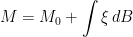
–
 be a d-dimensional Brownian motion defined on the
  , and suppose that
  .
. 

 satisfying
  , almost surely, for each
  .
.  will be normal with mean zero and variance c(t–s) for times
  . So, scaling the time axis of Brownian motion B to get the new process
  just results in another Brownian motion scaled by the factor
  .
.
 and Brownian motion B on the
  . If
. If  is finite for each
  then the stochastic integral
 has variance
 ![\displaystyle \setlength\arraycolsep{2pt} \begin{array}{rl} \displaystyle{\mathbb E}\left[\left(\int_s^t\xi\,dB\right)^2\right]&\displaystyle={\mathbb E}\left[\int_s^t\xi^2_u\,du\right]\smallskip\\ &\displaystyle=\theta(t)-\theta(s)\smallskip\\ &\displaystyle={\mathbb E}\left[(B_{\theta(t)}-B_{\theta(s)})^2\right]. \end{array}](https://s0.wp.com/latex.php?latex=%5Cdisplaystyle++%5Csetlength%5Carraycolsep%7B2pt%7D+%5Cbegin%7Barray%7D%7Brl%7D+%5Cdisplaystyle%7B%5Cmathbb+E%7D%5Cleft%5B%5Cleft%28%5Cint_s%5Et%5Cxi%5C%2CdB%5Cright%29%5E2%5Cright%5D%26%5Cdisplaystyle%3D%7B%5Cmathbb+E%7D%5Cleft%5B%5Cint_s%5Et%5Cxi%5E2_u%5C%2Cdu%5Cright%5D%5Csmallskip%5C%5C+%26%5Cdisplaystyle%3D%5Ctheta%28t%29-%5Ctheta%28s%29%5Csmallskip%5C%5C+%26%5Cdisplaystyle%3D%7B%5Cmathbb+E%7D%5Cleft%5B%28B_%7B%5Ctheta%28t%29%7D-B_%7B%5Ctheta%28s%29%7D%29%5E2%5Cright%5D.+%5Cend%7Barray%7D+&bg=ffffff&fg=000000&s=0&c=20201002)
 has the same distribution as the time-changed Brownian motion
  .
. , is defined to be a real-valued process satisfying the following properties.
 .
. is normally distributed with mean 0 and variance t–s independently of
  , for any
  is
is  -measurable, and
  for each
 ![{[B]_t=t}](https://s0.wp.com/latex.php?latex=%7B%5BB%5D_t%3Dt%7D&bg=ffffff&fg=000000&s=0&c=20201002) . An incredibly useful result is that the converse statement holds. That is, Brownian motion is the only
. An incredibly useful result is that the converse statement holds. That is, Brownian motion is the only  . Then, the following are equivalent.
  is a local martingale.
 ![{[X]_t=t}](https://s0.wp.com/latex.php?latex=%7B%5BX%5D_t%3Dt%7D&bg=ffffff&fg=000000&s=0&c=20201002) .
.  is its maximum process.
 there exist positive constants
  such that, for all local martingales X with
  , the following inequality holds.
 ![\displaystyle c_p{\mathbb E}\left[ [X]^{p/2}_\tau\right]\le{\mathbb E}\left[(X^*_\tau)^p\right]\le C_p{\mathbb E}\left[ [X]^{p/2}_\tau\right].](https://s0.wp.com/latex.php?latex=%5Cdisplaystyle++c_p%7B%5Cmathbb+E%7D%5Cleft%5B+%5BX%5D%5E%7Bp%2F2%7D_%5Ctau%5Cright%5D%5Cle%7B%5Cmathbb+E%7D%5Cleft%5B%28X%5E%2A_%5Ctau%29%5Ep%5Cright%5D%5Cle+C_p%7B%5Cmathbb+E%7D%5Cleft%5B+%5BX%5D%5E%7Bp%2F2%7D_%5Ctau%5Cright%5D.+&bg=ffffff&fg=000000&s=0&c=20201002)
 .
.  , the theorem can also be stated as follows. The set of all cadlag martingales X starting from zero for which
 ![{{\mathbb E}[(X^*_\infty)^p]}](https://s0.wp.com/latex.php?latex=%7B%7B%5Cmathbb+E%7D%5B%28X%5E%2A_%5Cinfty%29%5Ep%5D%7D&bg=ffffff&fg=000000&s=0&c=20201002) is finite is a vector space, and the BDG inequality states that the norms
is finite is a vector space, and the BDG inequality states that the norms ![{X\mapsto\Vert X^*_\infty\Vert_p={\mathbb E}[(X^*_\infty)^p]^{1/p}}](https://s0.wp.com/latex.php?latex=%7BX%5Cmapsto%5CVert+X%5E%2A_%5Cinfty%5CVert_p%3D%7B%5Cmathbb+E%7D%5B%28X%5E%2A_%5Cinfty%29%5Ep%5D%5E%7B1%2Fp%7D%7D&bg=ffffff&fg=000000&s=0&c=20201002) and
and ![{X\mapsto\Vert[X]^{1/2}_\infty\Vert_p}](https://s0.wp.com/latex.php?latex=%7BX%5Cmapsto%5CVert%5BX%5D%5E%7B1%2F2%7D_%5Cinfty%5CVert_p%7D&bg=ffffff&fg=000000&s=0&c=20201002) are equivalent.
are equivalent. ,
,  . The significance of Theorem
  .
.![{\left[\int\xi\,dX\right]=\int\xi^2\,d[X]}](https://s0.wp.com/latex.php?latex=%7B%5Cleft%5B%5Cint%5Cxi%5C%2CdX%5Cright%5D%3D%5Cint%5Cxi%5E2%5C%2Cd%5BX%5D%7D&bg=ffffff&fg=000000&s=0&c=20201002) . Recall, also, that stochastic integration
. Recall, also, that stochastic integration  -integrable martingales, for
  .
. , so that
 ![{{\mathbb E}[\vert X_t\vert^p]<\infty}](https://s0.wp.com/latex.php?latex=%7B%7B%5Cmathbb+E%7D%5B%5Cvert+X_t%5Cvert%5Ep%5D%3C%5Cinfty%7D&bg=ffffff&fg=000000&s=0&c=20201002) for each t. Then, for any bounded predictable process
for each t. Then, for any bounded predictable process  is also an
  is a continuous local martingale.
 ![\displaystyle \int_0^t\xi^2\,d[X]<\infty](https://s0.wp.com/latex.php?latex=%5Cdisplaystyle++%5Cint_0%5Et%5Cxi%5E2%5C%2Cd%5BX%5D%3C%5Cinfty+&bg=ffffff&fg=000000&s=0&c=20201002)
 is a martingale.
![{X^2-[X]}](https://s0.wp.com/latex.php?latex=%7BX%5E2-%5BX%5D%7D&bg=ffffff&fg=000000&s=0&c=20201002) is a local martingale for all local martingales X.
is a local martingale for all local martingales X. ![\displaystyle XY-[X,Y] = X_0Y_0+\int X_-\,dY+\int Y_-\,dX](https://s0.wp.com/latex.php?latex=%5Cdisplaystyle++XY-%5BX%2CY%5D+%3D+X_0Y_0%2B%5Cint+X_-%5C%2CdY%2B%5Cint+Y_-%5C%2CdX+&bg=ffffff&fg=000000&s=0&c=20201002)
 for some constant K. Then, as
  such that
  converges to
  by
by  if necessary so that, being nonnegative elementary integrals of a submartingale,
  will be submartingales. Also,
  . Recall that a cadlag adapted process X is
  is locally integrable, and all local submartingales are locally integrable. So,
 gives,
 .
. for some
  and
and  .
.  Almost Sure