In this post, I give an example of a class of processes which can be expressed as integrals with respect to Brownian motion, but are not themselves martingales. As stochastic integration preserves the local martingale property, such processes are guaranteed to be at least local martingales. However, this is not enough to conclude that they are proper martingales. Whereas constructing examples of local martingales which are not martingales is a relatively straightforward exercise, such examples are often slightly contrived and the martingale property fails for obvious reasons (e.g., double-loss betting strategies). The aim here is to show that the martingale property can fail for very simple stochastic differential equations which are likely to be met in practice, and it is not always obvious when this situation arises.
Consider the following stochastic differential equation
 |
(1) |
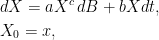
for a nonnegative process X. Here, B is a Brownian motion and a,b,c,x are positive constants. This a common SDE appearing, for example, in the constant elasticity of variance model for option pricing. Now consider the following question: what is the expected value of X at time t?
The obvious answer seems to be that ![{{\mathbb E}[X_t]=xe^{bt}}](https://s0.wp.com/latex.php?latex=%7B%7B%5Cmathbb+E%7D%5BX_t%5D%3Dxe%5E%7Bbt%7D%7D&bg=ffffff&fg=000000&s=0&c=20201002) , based on the idea that X has growth rate b on average. A more detailed argument is to write out (1) in integral form
, based on the idea that X has growth rate b on average. A more detailed argument is to write out (1) in integral form
 |
(2) |
The next step is to note that the first integral is with respect to Brownian motion, so has zero expectation. Therefore,
This can be differentiated to obtain the ordinary differential equation ![{d{\mathbb E}[X_t]/dt=b{\mathbb E}[X_t]}](https://s0.wp.com/latex.php?latex=%7Bd%7B%5Cmathbb+E%7D%5BX_t%5D%2Fdt%3Db%7B%5Cmathbb+E%7D%5BX_t%5D%7D&bg=ffffff&fg=000000&s=0&c=20201002) , which has the unique solution
, which has the unique solution ![{{\mathbb E}[X_t]={\mathbb E}[X_0]e^{bt}}](https://s0.wp.com/latex.php?latex=%7B%7B%5Cmathbb+E%7D%5BX_t%5D%3D%7B%5Cmathbb+E%7D%5BX_0%5De%5E%7Bbt%7D%7D&bg=ffffff&fg=000000&s=0&c=20201002) .
.
In fact this argument is false. For  there is no problem, and as expected. However, for all
  the conclusion is wrong, and the strict inequality
 ![{{\mathbb E}[X_t]<xe^{bt}}](https://s0.wp.com/latex.php?latex=%7B%7B%5Cmathbb+E%7D%5BX_t%5D%3Cxe%5E%7Bbt%7D%7D&bg=ffffff&fg=000000&s=0&c=20201002) holds.
holds.
The point where the argument above falls apart is the statement that the first integral in (2) has zero expectation. This would indeed follow if it was known that it is a martingale, as is often assumed to be true for stochastic integrals with respect to Brownian motion. However, stochastic integration preserves the local martingale property and not, in general, the martingale property itself. If then we have exactly this situation, where only the local martingale property holds. The first integral in (2) is not a proper martingale, and has strictly negative expectation at all positive times. The reason that the martingale property fails here for is that the coefficient  of dB grows too fast in X.
In this post, I will mainly be concerned with the special case of (1) with a=1 and zero drift.
 |
(3) |
The general form (1) can be reduced to this special case, as I describe below. SDEs (1) and (3) do have unique solutions, as I will prove later. Then, as X is a nonnegative local martingale, if it ever hits zero then it must remain there (0 is an absorbing boundary).
The solution X to (3) has the following properties, which will be proven later in this post.
Continue reading “Failure of the Martingale Property” →
![\displaystyle \setlength\arraycolsep{2pt} \begin{array}{rl} &\displaystyle{\mathbb E}\left[e^{ia\cdot (X_t-X_0)}\right] = \exp(t\psi(a)),\smallskip\\ &\displaystyle\psi(a)=ia\cdot b-\frac12a^{\rm T}\Sigma a+\int_{{\mathbb R}^d}\left(e^{ia\cdot x}-1-\frac{ia\cdot x}{1+\Vert x\Vert}\right)\,d\nu(x). \end{array}](https://s0.wp.com/latex.php?latex=%5Cdisplaystyle++%5Csetlength%5Carraycolsep%7B2pt%7D+%5Cbegin%7Barray%7D%7Brl%7D+%26%5Cdisplaystyle%7B%5Cmathbb+E%7D%5Cleft%5Be%5E%7Bia%5Ccdot+%28X_t-X_0%29%7D%5Cright%5D+%3D+%5Cexp%28t%5Cpsi%28a%29%29%2C%5Csmallskip%5C%5C+%26%5Cdisplaystyle%5Cpsi%28a%29%3Dia%5Ccdot+b-%5Cfrac12a%5E%7B%5Crm+T%7D%5CSigma+a%2B%5Cint_%7B%7B%5Cmathbb+R%7D%5Ed%7D%5Cleft%28e%5E%7Bia%5Ccdot+x%7D-1-%5Cfrac%7Bia%5Ccdot+x%7D%7B1%2B%5CVert+x%5CVert%7D%5Cright%29%5C%2Cd%5Cnu%28x%29.+%5Cend%7Barray%7D+&bg=ffffff&fg=000000&s=0&c=20201002)

 such that
  is independent of
  for any
  .
.  has the same distribution as
  for any
  .
.  in probability as s tends to t.
 . In that case, we also require that X is adapted to the filtration and that
  for all
  . In particular, if X is a Lévy process according to definition
  . Note that slightly different definitions are sometimes used by different authors. It is often required that
  is zero and that X has
  independently of
  has probability density function p and characteristic function
  given by,
 ![\displaystyle \setlength\arraycolsep{2pt} \begin{array}{rl} &\displaystyle p(x)=\frac{\gamma}{\pi(\gamma^2+x^2)},\smallskip\\ &\displaystyle\phi(a)\equiv{\mathbb E}\left[e^{iaX}\right]=e^{-\gamma\vert a\vert}. \end{array}](https://s0.wp.com/latex.php?latex=%5Cdisplaystyle++%5Csetlength%5Carraycolsep%7B2pt%7D+%5Cbegin%7Barray%7D%7Brl%7D+%26%5Cdisplaystyle+p%28x%29%3D%5Cfrac%7B%5Cgamma%7D%7B%5Cpi%28%5Cgamma%5E2%2Bx%5E2%29%7D%2C%5Csmallskip%5C%5C+%26%5Cdisplaystyle%5Cphi%28a%29%5Cequiv%7B%5Cmathbb+E%7D%5Cleft%5Be%5E%7BiaX%7D%5Cright%5D%3De%5E%7B-%5Cgamma%5Cvert+a%5Cvert%7D.+%5Cend%7Barray%7D+&bg=ffffff&fg=000000&s=0&c=20201002)
 and
and  respectively then
  is Cauchy with parameter
  . We can therefore consistently define a stochastic process
  such that
  , for any
  , where
  describes the covariance structure of the Brownian motion component, b is the drift component, and
  describes the rate at which jumps occur. The distribution of the process is given by the Lévy-Khintchine formula, equation (
 such that
 ![\displaystyle {\mathbb E}\left[e^{ia\cdot (X_t-X_0)}\right]=e^{t\psi(a)}](https://s0.wp.com/latex.php?latex=%5Cdisplaystyle++%7B%5Cmathbb+E%7D%5Cleft%5Be%5E%7Bia%5Ccdot+%28X_t-X_0%29%7D%5Cright%5D%3De%5E%7Bt%5Cpsi%28a%29%7D+&bg=ffffff&fg=000000&s=0&c=20201002)
 and
and  . Also,
  can be written as
 is a positive semidefinite matrix.
  .
.  and,
and,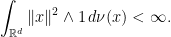
 .
. has the independent increments property if
  . More generally, we say that X has the independent increments property with respect to an underlying
  where
where  is a measure describing the jumps of X,
  ,
,  such that
  and
and ![\displaystyle {\mathbb E}\left[e^{ia\cdot (X_t-X_0)}\right]=e^{i\psi_t(a)}](https://s0.wp.com/latex.php?latex=%5Cdisplaystyle++%7B%5Cmathbb+E%7D%5Cleft%5Be%5E%7Bia%5Ccdot+%28X_t-X_0%29%7D%5Cright%5D%3De%5E%7Bi%5Cpsi_t%28a%29%7D+&bg=ffffff&fg=000000&s=0&c=20201002)
 can be written as
 ![\displaystyle \psi_t(a)=ia\cdot b_t-\frac{1}{2}a^{\rm T}\Sigma_t a+\int _{{\mathbb R}^d\times[0,t]}\left(e^{ia\cdot x}-1-\frac{ia\cdot x}{1+\Vert x\Vert}\right)\,d\mu(x,s)](https://s0.wp.com/latex.php?latex=%5Cdisplaystyle++%5Cpsi_t%28a%29%3Dia%5Ccdot+b_t-%5Cfrac%7B1%7D%7B2%7Da%5E%7B%5Crm+T%7D%5CSigma_t+a%2B%5Cint+_%7B%7B%5Cmathbb+R%7D%5Ed%5Ctimes%5B0%2Ct%5D%7D%5Cleft%28e%5E%7Bia%5Ccdot+x%7D-1-%5Cfrac%7Bia%5Ccdot+x%7D%7B1%2B%5CVert+x%5CVert%7D%5Cright%29%5C%2Cd%5Cmu%28x%2Cs%29+&bg=ffffff&fg=000000&s=0&c=20201002)
 ,
,  and
and  is a continuous function from
  to
to  such that
  and
and  is positive semidefinite for all
  .
.  is a continuous function from
  .
.  with
with  ,
,  for all
  and,
and,![\displaystyle \int_{{\mathbb R}^d\times[0,t]}\Vert x\Vert^2\wedge 1\,d\mu(x,s)<\infty.](https://s0.wp.com/latex.php?latex=%5Cdisplaystyle++%5Cint_%7B%7B%5Cmathbb+R%7D%5Ed%5Ctimes%5B0%2Ct%5D%7D%5CVert+x%5CVert%5E2%5Cwedge+1%5C%2Cd%5Cmu%28x%2Cs%29%3C%5Cinfty.+&bg=ffffff&fg=000000&s=0&c=20201002)
 for
for  , the process hits zero. This idea extends to all continuous and nonnegative local martingales. The Girsanov transform method applied here is essentially the same as that used by Carlos A. Sin (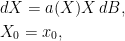
 , B is a Brownian motion and the fixed initial condition
  is strictly positive. The multiplier X in the coefficient of dB ensures that if X ever hits zero then it stays there. By
  is locally integrable on
  . Consider also the following SDE,
![\displaystyle {\mathbb E}[X_t]=x+\int_0^tb{\mathbb E}[X_s]\,ds.](https://s0.wp.com/latex.php?latex=%5Cdisplaystyle++%7B%5Cmathbb+E%7D%5BX_t%5D%3Dx%2B%5Cint_0%5Etb%7B%5Cmathbb+E%7D%5BX_s%5D%5C%2Cds.+&bg=ffffff&fg=000000&s=0&c=20201002)
![\displaystyle {\mathbb E}[X_t\mid\mathcal{F}_s]<X_s](https://s0.wp.com/latex.php?latex=%5Cdisplaystyle++%7B%5Cmathbb+E%7D%5BX_t%5Cmid%5Cmathcal%7BF%7D_s%5D%3CX_s+&bg=ffffff&fg=000000&s=0&c=20201002)
 ,
, ![{{\mathbb E}[X_t^p]}](https://s0.wp.com/latex.php?latex=%7B%7B%5Cmathbb+E%7D%5BX_t%5Ep%5D%7D&bg=ffffff&fg=000000&s=0&c=20201002) is bounded over
is bounded over  .
. has the standard
  are independent normal with zero mean and unit variance. A well known fact of such distributions is that they are invariant under rotations, which has the following consequence. The distribution of
  is invariant under rotations of
  and, hence, is fully determined by the values of
  and
and  . This is known as the
  . The moment generating function can be computed,
![\displaystyle M_Z(\lambda)\equiv{\mathbb E}\left[e^{\lambda Z}\right]=\left(1-2\lambda\right)^{-\frac{n}{2}}\exp\left(\frac{\lambda\mu}{1-2\lambda}\right),](https://s0.wp.com/latex.php?latex=%5Cdisplaystyle++M_Z%28%5Clambda%29%5Cequiv%7B%5Cmathbb+E%7D%5Cleft%5Be%5E%7B%5Clambda+Z%7D%5Cright%5D%3D%5Cleft%281-2%5Clambda%5Cright%29%5E%7B-%5Cfrac%7Bn%7D%7B2%7D%7D%5Cexp%5Cleft%28%5Cfrac%7B%5Clambda%5Cmu%7D%7B1-2%5Clambda%7D%5Cright%29%2C+&bg=ffffff&fg=000000&s=0&c=20201002)
 with real part bounded above by 1/2.
 of an n-dimensional
  be its
  has the following property. For times
  is distributed as
  . This is known as the `n-dimensional’ squared Bessel process, and denoted by
  .
.
![\displaystyle dX = 2\sum_iB^i\,dB^i+\sum_id[B^i].](https://s0.wp.com/latex.php?latex=%5Cdisplaystyle++dX+%3D+2%5Csum_iB%5Ei%5C%2CdB%5Ei%2B%5Csum_id%5BB%5Ei%5D.+&bg=ffffff&fg=000000&s=0&c=20201002)
![{[B^i]_t=t}](https://s0.wp.com/latex.php?latex=%7B%5BB%5Ei%5D_t%3Dt%7D&bg=ffffff&fg=000000&s=0&c=20201002) , the final term on the right-hand-side is equal to
, the final term on the right-hand-side is equal to  . Also, the covarations
 ![{[B^i,B^j]}](https://s0.wp.com/latex.php?latex=%7B%5BB%5Ei%2CB%5Ej%5D%7D&bg=ffffff&fg=000000&s=0&c=20201002) are zero for
are zero for  from which it can be seen that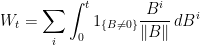
![{[W]_t=t}](https://s0.wp.com/latex.php?latex=%7B%5BW%5D_t%3Dt%7D&bg=ffffff&fg=000000&s=0&c=20201002) . By
. By 
 is not Lipschitz continuous. It is known that (
 . This can be done either by specifying its distributions in terms of chi-square distributions or by the SDE (
 and
and  are independent, then
  has moment generating function
  and, therefore, has the
  distribution. That such distributions do indeed exist can be seen by constructing them. The
  distribution is a special case of the
  . If
. If  is a sequence of independent random variables with the standard normal distribution and T independently has the
  , then
  , which can be seen by computing its moment generating function. Adding an independent
  .
. distribution.
  satisfies certain continuity conditions. Many of the standard processes we study satisfy the Feller property, such as
  .
.
 . Equivalently,
 ![\displaystyle {\mathbb E}[f(X_t)\mid\mathcal{F}_s]=P_{t-s}f(X_s)](https://s0.wp.com/latex.php?latex=%5Cdisplaystyle++%7B%5Cmathbb+E%7D%5Bf%28X_t%29%5Cmid%5Cmathcal%7BF%7D_s%5D%3DP_%7Bt-s%7Df%28X_s%29+&bg=ffffff&fg=000000&s=0&c=20201002)
 . The strong Markov property generalizes this idea to arbitrary stopping times.
 be a transition function.
 , conditioned on
  the process
  is Markov with the given transition function and with respect to the filtration
  .
.  . The reflection principle
 defined to be equal to B up until time
 . If
. If  then either the process itself ends up above K or it hits K and then drops below this level by time t, in which case
  . So, by the reflection principle,
 . It will be assumed that E is
  , topological manifolds and, indeed, any open or closed subset of another lccb space. Such spaces are always
  denotes the continuous real-valued functions
  , the set
  is compact. Equivalently, its extension to the
  of E given by
  is continuous. The set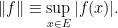
 , so it makes sense to talk of transition probabilities and functions on E.
 ,
,  .
.  is continuous with respect to the norm topology on
  .
.
 be the sigma-algebra generated by
  . The Markov property then says that, for any times
  and bounded measurable function
  conditional on
  . Equivalently,
 ![\displaystyle {\mathbb E}\left[f(X_t)\mid\mathcal{F}_s\right]={\mathbb E}\left[f(X_t)\mid X_s\right]](https://s0.wp.com/latex.php?latex=%5Cdisplaystyle++%7B%5Cmathbb+E%7D%5Cleft%5Bf%28X_t%29%5Cmid%5Cmathcal%7BF%7D_s%5Cright%5D%3D%7B%5Cmathbb+E%7D%5Cleft%5Bf%28X_t%29%5Cmid+X_s%5Cright%5D+&bg=ffffff&fg=000000&s=0&c=20201002)
 . A process X is Markov with respect to
  if it is adapted and (
 , denoted by
  , if it takes values in the set of nonnegative integers and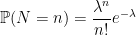
 . The mean and variance of N are both equal to
 ![\displaystyle {\mathbb E}\left[e^{aN}\right] = \exp\left(\lambda(e^a-1)\right),](https://s0.wp.com/latex.php?latex=%5Cdisplaystyle++%7B%5Cmathbb+E%7D%5Cleft%5Be%5E%7BaN%7D%5Cright%5D+%3D+%5Cexp%5Cleft%28%5Clambda%28e%5Ea-1%29%5Cright%29%2C+&bg=ffffff&fg=000000&s=0&c=20201002)
 . From this, it can be seen that the sum of independent Poisson random variables with parameters
  . The Poisson distribution occurs as a limit of
  , is the sum of m independent
  -valued random variables each with probability p of being 1. Explicitly, if
  then
then 
 and
and  such that
  , it can be verified that this tends to the Poisson distribution (
 is a
is a  and
and  independently of
  Almost Sure