Theory and applications of probability and stochastic processes: e.g. central limit theorems, large deviations, stochastic differential equations, models from statistical mechanics, queuing theory
Having defined optional and predictable projections in an earlier post, I now look at their basic properties. The first nontrivial property is that they are well-defined in the first place. Recall that existence of the projections made use of the existence of cadlag modifications of martingales, and uniqueness relied on the section theorems. By contrast, once we accept that optional and predictable projections are well-defined, everything in this post follows easily. Nothing here requires any further advanced results of stochastic process theory.
Optional and predictable projections are similar in nature to conditional expectations. Given a probability space and a sub-sigma-algebra , the conditional expectation of an (-measurable) random variable X is a -measurable random variable . This is defined whenever the integrability condition (a.s.) is satisfied, only depends on X up to almost-sure equivalence, and Y is defined up to almost-sure equivalence. That is, a random variable almost surely equal to X has the same conditional expectation as X. Similarly, a random variable almost-surely equal to Y is also a version of the conditional expectation .
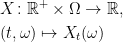
The setup with projections of stochastic processes is similar. We start with a filtered probability space, and a (real-valued) stochastic process is a map
which we assume to be jointly-measurable. That is, it is measurable with respect to the Borel sigma-algebra on the image, and the product sigma-algebra on the domain. The optional and predictable sigma-algebras are contained in the product,
We do not have a reference measure on in order to define conditional expectations with respect to and . However, the optional projection and predictable projection play similar roles. Assuming that the necessary integrability properties are satisfied, then the projections exist. Furthermore, the projection only depends on the process Xup to evanescence (i.e., up to a zero probability set), and and are uniquely defined up to evanescence.
In what follows, we work with respect to a complete filtered probability space. Processes are always only considered up to evanescence, so statements involving equalities, inequalities, and limits of processes are only required to hold outside of a zero probability set. When we say that the optional projection of a process exists, we mean that the integrability condition in the definition of the projection is satisfied. Specifically, that is almost surely finite. Similarly for the predictable projection.
The following lemma gives a list of initial properties of the optional projection. Other than the statement involving stopping times, they all correspond to properties of conditional expectations.
Lemma 1
X is optional if and only if exists and is equal to X.
If the optional projection of X exists then,
(1)
If the optional projections of X and Y exist, and are -measurable random variables, then,
(2)
If the optional projection of X exists and U is an optional process then,
(3)
If the optional projection of X exists and is a stopping time then, the optional projection of the stopped process exists and,
(4)
If and the optional projections of X and Y exist then, .
The aim of this post is to give a direct proof of the theorems of measurable projection and measurable section. These are generally regarded as rather difficult results, and proofs often use ideas from descriptive set theory such as analytic sets. I did previously post a proof along those lines on this blog. However, the results can be obtained in a more direct way, which is the purpose of this post. Here, I present relatively self-contained proofs which do not require knowledge of any advanced topics beyond basic probability theory.
The projection theorem states that if is a complete probability space, then the projection of a measurable subset of onto is measurable. To be precise, the condition is that S is in the product sigma-algebra , where denotes the Borel sets in , and the projection map is denoted
Then, measurable projection states that . Although it looks like a very basic property of measurable sets, maybe even obvious, measurable projection is a surprisingly difficult result to prove. In fact, the requirement that the probability space is complete is necessary and, if it is dropped, then need not be measurable. Counterexamples exist for commonly used measurable spaces such as and . This suggests that there is something deeper going on here than basic manipulations of measurable sets.
By definition, if then, for every , there exists a such that . The measurable section theorem — also known as measurable selection — says that this choice can be made in a measurable way. That is, if S is in then there is a measurable section,
It is convenient to extend to the whole of by setting outside of .
Figure 1: A section of a measurable set
The graph of is
The condition that whenever can alternatively be expressed by stating that . This also ensures that is a subset of , and is a section of S on the whole of if and only if .
The results described here can also be used to prove the optional and predictable section theorems which, at first appearances, also seem to be quite basic statements. The section theorems are fundamental to the powerful and interesting theory of optional and predictable projection which is, consequently, generally considered to be a hard part of stochastic calculus. In fact, the projection and section theorems are really not that hard to prove.
Let us consider how one might try and approach a proof of the projection theorem. As with many statements regarding measurable sets, we could try and prove the result first for certain simple sets, and then generalise to measurable sets by use of the monotone class theorem or similar. For example, let denote the collection of all for which . It is straightforward to show that any finite union of sets of the form for and are in . If it could be shown that is closed under taking limits of increasing and decreasing sequences of sets, then the result would follow from the monotone class theorem. Increasing sequences are easily handled — if is a sequence of subsets of then from the definition of the projection map,
If for each n, this shows that the union is again in . Unfortunately, decreasing sequences are much more problematic. If for all then we would like to use something like
(1)
However, this identity does not hold in general. For example, consider the decreasing sequence . Then, for all n, but is empty, contradicting (1). There is some interesting history involved here. In a paper published in 1905, Henri Lebesgue claimed that the projection of a Borel subset of onto is itself measurable. This was based upon mistakenly applying (1). The error was spotted in around 1917 by Mikhail Suslin, who realised that the projection need not be Borel, and lead him to develop the theory of analytic sets.
Actually, there is at least one situation where (1) can be shown to hold. Suppose that for each , the slices
(2)
are compact. For each , the slices give a decreasing sequence of nonempty compact sets, so has nonempty intersection. So, letting S be the intersection , the slice is nonempty. Hence, , and (1) follows.
The starting point for our proof of the projection and section theorems is to consider certain special subsets of where the compactness argument, as just described, can be used. The notation is used to represent the collection of countable intersections, , of sets in .
Lemma 1 Let be a measurable space, and be the collection of subsets of which are finite unions over compact intervals and . Then, for any , we have , and the debut
Given a sequence of real-valued random variables defined on a probability space , it is a standard result that the supremum
is measurable. To ensure that this is well-defined, we need to allow X to have values in , so that whenever the sequence is unbounded above. The proof of this fact is simple. We just need to show that is in for all . Writing,
the properties that are measurable and that the sigma-algebra is closed under countable intersections gives the result.
The measurability of the suprema of sequences of random variables is a vital property, used throughout probability theory. However, once we start looking at uncountable collections of random variables things get more complicated. Given a, possibly uncountable, collection of random variables , the supremum is,
(1)
However, there are a couple of reasons why this is often not a useful construction:
The supremum need not be measurable. For example, consider the probability space with the collection of Borel or Lebesgue subsets of , and the standard Lebesgue measure. For any define the random variable and, for a subset A of , consider the collection of random variables . Its supremum is
which is not measurable if A is a non-measurable set (e.g., a Vitali set).
Even if the supremum is measurable, it might not be a useful quantity. Letting be the random variables on constructed above, consider . Its supremum is the constant function . As every is almost surely equal to 0, it is almost surely bounded above by the constant function . So, the supremum is larger than we may expect, and is not what we want in many cases.
The essential supremum can be used to correct these deficiencies, and has been important in several places in my notes. See, for example, the proof of the debut theorem for right-continuous processes. So, I am posting this to use as a reference. Note that there is an alternative use of the term `essential supremum’ to refer to the smallest real number almost surely bounding a specified random variable, which is the one referred to by Wikipedia. This is different from the use here, where we look at a collection of random variables and the essential supremum is itself a random variable.
The essential supremum is really just the supremum taken within the equivalence classes of random variables under the almost sure ordering. Consider the equivalence relation if and only if almost surely. Writing for the equivalence class of X, we can consider the ordering given by if almost surely. Then, the equivalence class of the essential supremum of a collection of random variables is the supremum of the equivalence classes of the elements of . In order to avoid issues with unbounded sets, we consider random variables taking values in the extended reals.
Definition 1 An essential supremum of a collection of -valued random variables,
is the least upper bound of , using the almost-sure ordering on random variables. That is, S is an -valued random variable satisfying
upper bound: almost surely, for all .
minimality: for all -valued random variables Y satisfying almost surely for all , we have almost surely.
I will give a proof of the measurable section theorem, also known as measurable selection. Given a complete probability space , we denote the projection from by
By definition, if then, for every , there exists a such that . The measurable section theorem says that this choice can be made in a measurable way. That is, using to denote the Borel sigma-algebra, if S is in the product sigma-algebra then and there is a measurable map
It is convenient to extend to the whole of by setting outside of .
Figure 1: A section of a measurable set
We consider measurable functions . The graph of is
The condition that whenever can then be expressed by stating that . This also ensures that is a subset of , and is a section of S on the whole of if and only if .
The proof of the measurable section theorem will make use of the properties of analytic sets and of the Choquet capacitability theorem, as described in the previous two posts. [Note: I have since posted a more direct proof which does not involve such prerequisites.] Recall that a paving on a set X denotes, simply, a collection of subsets of X. The pair is then referred to as a paved space. Given a pair of paved spaces and , the product paving denotes the collection of cartesian products for and , which is a paving on . The notation is used for the collection of countable intersections of a paving .
We start by showing that measurable section holds in a very simple case where, for the section of a set S, its debut will suffice. The debut is the map
We use the convention that the infimum of the empty set is . It is not clear that is measurable, and we do not rely on this, although measurable projection can be used to show that it is measurable whenever S is in .
Lemma 1 Let be a measurable space, be the collection of compact intervals in , and be the closure of the paving under finite unions.
Then, the debut of any is measurable and its graph is contained in S.
In this post I will give a proof of the measurable projection theorem. Recall that this states that for a complete probability space and a set S in the product sigma-algebra , the projection, , of S onto , is in . The previous post on analytic sets made some progress towards this result. Indeed, using the definitions and results given there, it follows quickly that is -analytic. To complete the proof of measurable projection, it is necessary to show that analytic sets are measurable. This is a consequence of Choquet’s capacitability theorem, which I will prove in this post. Measurable projection follows as a simple consequence.
The condition that the underlying probability space is complete is necessary and, if this condition was dropped, then the result would no longer hold. Recall that, if is a probability space, then the completion, , of with respect to consists of the sets such that there exists with and . The probability space is complete if . More generally, can be uniquely extended to a measure on the sigma-algebra by setting , where B and C are as above. Then is the completion of .
In measurable projection, then, it needs to be shown that if is the projection of a set in , then A is in the completion of . That is, we need to find sets with with . In fact, it is always possible to find a in which minimises , and its measure is referred to as the outer measure of A. For any probability measure , we can define an outer measure on the subsets of , by approximating from above,
(1)
Similarly, we can define an inner measure by approximating A from below,
It can be shown that A is -measurable if and only if . We will be concerned primarily with the outer measure , and will show that that if A is the projection of some , then A can be approximated from below in the following sense: there exists in for which . From this, it will follow that A is in the completion of .
It is convenient to prove the capacitability theorem in slightly greater generality than just for the outer measure . The only properties of that are required is that it is a capacity, which we now define. Recall that a paving on a set X is simply any collection of subsets of X, and we refer to the pair as a paved space.
Definition 1 Let be a paved space. Then, an -capacity is a map which is increasing, continuous along increasing sequences, and continuous along decreasing sequences in . That is,
if then .
if is increasing in n then as .
if is decreasing in n then as .
As was claimed above, the outer measure defined by (1) is indeed a capacity.
We will shortly give a proof of measurable projection and, also, of the section theorems. Starting with the projection theorem, recall that this states that if is a complete probability space, then the projection of any measurable subset of onto is measurable. To be precise, the condition is that S is in the product sigma-algebra , where denotes the Borel sets in , and is the projection . Then, . Although it looks like a very basic property of measurable sets, maybe even obvious, measurable projection is a surprisingly difficult result to prove. In fact, the requirement that the probability space is complete is necessary and, if it is dropped, then need not be measurable. Counterexamples exist for commonly used measurable spaces such as and . This suggests that there is something deeper going on here than basic manipulations of measurable sets.
The techniques which will be used to prove the projection theorem involve analytic sets, which will be introduced in this post, with the proof of measurable projection to follow in the next post. [Note: I have since posted a more direct proof of measurable projection and section, which does not make use of analytic sets.] These results can also be used to prove the optional and predictable section theorems which, at first appearances, seem to be quite basic statements. The section theorems are fundamental to the powerful and interesting theory of optional and predictable projection which is, consequently, generally considered to be a hard part of stochastic calculus. In fact, the projection and section theorems are really not that hard to prove, although the method given here does require stepping outside of the usual setup used in probability and involves something more like descriptive set theory. Continue reading “Analytic Sets”→
It has been some time since my last post, but I am continuing now with the stochastic calculus notes on optional and predictable projection. In this post, I will go through the ideas in the discrete-time situation. All of the main concepts involved in optional and predictable projection are still present in discrete time, but the theory is much simpler. It is only really in continuous time that the projection theorems really show their power, so the aim of this post is to motivate the concepts in a simple setting before generalising to the full, continuous-time situation. Ideally, this would have been published before the posts on optional and predictable projection in continuous time, so it is a bit out of sequence.
We consider time running through the discrete index set , and work with respect to a filtered probability space. Then, is used to represent the collection of events observable up to and including time n. Stochastic processes will all be real-valued and defined up to almost-sure equivalence. That is, processes X and Y are considered to be the same if almost surely for each . The projections of a process X are defined as follows.
Definition 1 Let X be a measurable process. Then,
the optional projection, , exists if and only if is almost surely finite for each n, in which case
(1)
the predictable projection, , exists if and only if is almost surely finite for each n, in which case
holds for all symmetric convex subsets A and B of . By symmetric, we mean symmetric about the origin, so that is in A if and only is in A, and similarly for B. The standard Gaussian measure by definition has zero mean and covariance matrix equal to the nxn identity matrix, so that
with denoting the Lebesgue integral on . However, if it holds for the standard Gaussian measure, then the inequality can also be shown to hold for any centered (i.e., zero mean) Gaussian measure.
At the time of my original post, the Gaussian correlation conjecture was an unsolved mathematical problem, originally arising in the 1950s and formulated in its modern form in the 1970s. However, in the period since that post, the conjecture has been solved! A proof was published by Thomas Royen in 2014 [7]. This seems to have taken some time to come to the notice of much of the mathematical community. In December 2015, Rafał Latała, and Dariusz Matlak published a simplified version of Royen’s proof [4]. Although the original proof by Royen was already simple enough, it did consider a generalisation of the conjecture to a kind of multivariate gamma distribution. The exposition by Latała and Matlak ignores this generality and adds in some intermediate lemmas in order to improve readability and accessibility. Since then, the result has become widely known and, recently, has even been reported in the popular press [10,11]. There is an interesting article on Royen’s discovery of his proof at Quanta Magazine [12] including the background information that Royen was a 67 year old German retiree who supposedly came up with the idea while brushing his teeth one morning. Dick Lipton and Ken Regan have recently written about the history and eventual solution of the conjecture on their blog [5]. As it has now been shown to be true, I will stop referring to the result as a `conjecture’ and, instead, use the common alternative name — the Gaussian correlation inequality.
In this post, I will describe some equivalent formulations of the Gaussian correlation inequality, or GCI for short, before describing a general method of attacking this problem which has worked for earlier proofs of special cases. I will then describe Royen’s proof and we will see that it uses the same ideas, but with some key differences. Continue reading “The Gaussian Correlation Inequality”→
In this post, I introduce the concept of optional and predictable projections of jointly measurable processes. Optional projections of right-continuous processes and predictable projections of left-continuous processes were constructed in earlier posts, with the respective continuity conditions used to define the projection. These are, however, just special cases of the general theory. For arbitrary measurable processes, the projections cannot be expected to satisfy any such pathwise regularity conditions. Instead, we use the measurability criteria that the projections should be, respectively, optional and predictable.
The projection theorems are a relatively straightforward consequence of optional and predictable section. However, due to the difficulty of proving the section theorems, optional and predictable projection is generally considered to be an advanced or hard part of stochastic calculus. Here, I will make use of the section theorems as stated in an earlier post, but leave the proof of those until after developing the theory of projection.
As usual, we work with respect to a complete filtered probability space, and only consider real-valued processes. Any two processes are considered to be the same if they are equal up to evanescence. The optional projection is then defined (up to evanescence) by the following.
Theorem 1 (Optional Projection) Let X be a measurable process such that is almost surely finite for each stopping time. Then, there exists a unique optional process , referred to as the optional projection of X, satisfying
(1)
almost surely, for each stopping time .
Predictable projection is defined similarly.
Theorem 2 (Predictable Projection) Let X be a measurable process such that is almost surely finite for each predictable stopping time. Then, there exists a unique predictable process , referred to as the predictable projection of X, satisfying
(2)
almost surely, for each predictable stopping time .
As I have mentioned before in these notes, when working with processes in continuous time, it is important to select a good modification. Typically, this means that we work with processes which are left or right continuous. However, in general, it can be difficult to show that the paths of a process satisfy such pathwise regularity. In this post I show that for optional and predictable processes, the section theorems introduced in the previous post can be used to considerably simplify the situation. Although they are interesting results in their own right, the main application in these notes will be to optional and predictable projection. Once the projections are defined, the results from this post will imply that they preserve certain continuity properties of the process paths.
Suppose, for example, that we have a continuous-time process X which we want to show to be right-continuous. It is certainly necessary that, for any sequence of times decreasing to a limit , almost-surely tends to . However, even if we can prove this for every possible decreasing sequence , it does not follow that X is right-continuous. As a counterexample, if is any continuously distributed random time, then the process is not right-continuous. However, so long as the distribution of has no atoms, X is almost-surely continuous at each fixed time t. It is remarkable, then, that if we generalise to look at sequences of stopping times, then convergence in probability along decreasing sequences of stopping times is enough to guarantee everywhere right-continuity of the process. At least, it is enough so long as we restrict consideration to optional processes.
As usual, we work with respect to a complete filtered probability space. Two processes are considered to be the same if they are equal up to evanescence, and any pathwise property is said to hold if it holds up to evanescence. That is, a process is right-continuous if and only is it is everywhere right-continuous on a set of probability 1. All processes will be taken to be real-valued, and a process is said to have left (or right) limits if its left (or right) limits exist everywhere, up to evanescence, and are finite.
X is right-continuous if and only if in probability, for each uniformly bounded sequence of stopping times decreasing to a limit .
X has right limits if and only if converges in probability, for each uniformly bounded decreasing sequence of stopping times.
X has left limits if and only if converges in probability, for each uniformly bounded increasing sequence of stopping times.
The `only if’ parts of these statements is immediate, since convergence everywhere trivially implies convergence in probability. The importance of this theorem is in the `if’ directions. That is, it gives sufficient conditions to guarantee that the sample paths satisfy the respective regularity properties.
Note that conditions for left-continuity are absent from the statements of Theorem 1. In fact, left-continuity does not follow from the corresponding property along sequences of stopping times. Consider, for example, a Poisson process, X. This is right-continuous but not left-continuous. However, its jumps occur at totally inaccessible times. This implies that, for any sequence of stopping times increasing to a finite limit , it is true that converges almost surely to . In light of such examples, it is even more remarkable that right-continuity and the existence of left and right limits can be determined by just looking at convergence in probability along monotonic sequences of stopping times. Theorem 1 will be proven below, using the optional section theorem.


![{Y={\mathbb E}[X\,\vert\mathcal G]}](https://s0.wp.com/latex.php?latex=%7BY%3D%7B%5Cmathbb+E%7D%5BX%5C%2C%5Cvert%5Cmathcal+G%5D%7D&bg=ffffff&fg=000000&s=0&c=20201002)
![{{\mathbb E}[\lvert X\rvert\,\vert\mathcal G] < \infty}](https://s0.wp.com/latex.php?latex=%7B%7B%5Cmathbb+E%7D%5B%5Clvert+X%5Crvert%5C%2C%5Cvert%5Cmathcal+G%5D+%3C+%5Cinfty%7D&bg=ffffff&fg=000000&s=0&c=20201002)


![{{\mathbb E}[X\,\vert\mathcal G]}](https://s0.wp.com/latex.php?latex=%7B%7B%5Cmathbb+E%7D%5BX%5C%2C%5Cvert%5Cmathcal+G%5D%7D&bg=ffffff&fg=000000&s=0&c=20201002)







![{{\mathbb E}[1_{\{\tau < \infty\}}\lvert X_\tau\rvert\,\vert\mathcal F_\tau]}](https://s0.wp.com/latex.php?latex=%7B%7B%5Cmathbb+E%7D%5B1_%7B%5C%7B%5Ctau+%3C+%5Cinfty%5C%7D%7D%5Clvert+X_%5Ctau%5Crvert%5C%2C%5Cvert%5Cmathcal+F_%5Ctau%5D%7D&bg=ffffff&fg=000000&s=0&c=20201002)
are
-measurable random variables, then,
is a stopping time then, the optional projection of the stopped process
exists and,
and the optional projections of X and Y exist then,
.



![\displaystyle 1_{[0,\tau]}{}^{\rm o}(X^\tau)=1_{[0,\tau]}{}^{\rm o}\!X.](https://s0.wp.com/latex.php?latex=%5Cdisplaystyle++1_%7B%5B0%2C%5Ctau%5D%7D%7B%7D%5E%7B%5Crm+o%7D%28X%5E%5Ctau%29%3D1_%7B%5B0%2C%5Ctau%5D%7D%7B%7D%5E%7B%5Crm+o%7D%5C%21X.+&bg=ffffff&fg=000000&s=0&c=20201002)
 onto
onto  is measurable. To be precise, the condition is that S is in the product sigma-algebra
  , and the projection map is denoted
 . Although it looks like a very basic property of measurable sets, maybe even obvious, measurable projection is a surprisingly difficult result to prove. In fact, the requirement that the probability space is complete is necessary and, if it is dropped, then
  need not be measurable. Counterexamples exist for commonly used measurable spaces such as
  and
and  . This suggests that there is something deeper going on here than basic manipulations of measurable sets.
 then, for every
  , there exists a
  such that
  . The measurable section theorem — also known as measurable selection — says that this choice can be made in a measurable way. That is, if S is in
 outside of
![\displaystyle [\tau]=\left\{(t,\omega)\in{\mathbb R}\times\Omega\colon t=\tau(\omega)\right\}.](https://s0.wp.com/latex.php?latex=%5Cdisplaystyle++%5B%5Ctau%5D%3D%5Cleft%5C%7B%28t%2C%5Comega%29%5Cin%7B%5Cmathbb+R%7D%5Ctimes%5COmega%5Ccolon+t%3D%5Ctau%28%5Comega%29%5Cright%5C%7D.+&bg=ffffff&fg=000000&s=0&c=20201002)
 whenever
  can alternatively be expressed by stating that
 ![{[\tau]\subseteq S}](https://s0.wp.com/latex.php?latex=%7B%5B%5Ctau%5D%5Csubseteq+S%7D&bg=ffffff&fg=000000&s=0&c=20201002) . This also ensures that
. This also ensures that  is a subset of
  .
. denote the collection of all
  . It is straightforward to show that any finite union of sets of the form
  for
for  and
and  are in
  is a sequence of subsets of
 for each n, this shows that the union
  is again in
  for all
  then we would like to use something like
 . Then,
  for all n, but
  is empty, contradicting (
 onto
onto  , the slices
 , the slices
  give a decreasing sequence of nonempty compact sets, so has nonempty intersection. So, letting S be the intersection
  is nonempty. Hence,
  is used to represent the collection of countable intersections,
  , of sets
  in
in  .
. be a measurable space, and
  over compact intervals
  and
and  . Then, for any
  , we have
 of real-valued random variables defined on a probability space
 , so that
  whenever the sequence
  is unbounded above. The proof of this fact is simple. We just need to show that
 ![{X^{-1}((-\infty,a])}](https://s0.wp.com/latex.php?latex=%7BX%5E%7B-1%7D%28%28-%5Cinfty%2Ca%5D%29%7D&bg=ffffff&fg=000000&s=0&c=20201002) is in
is in  . Writing,
![\displaystyle X^{-1}((-\infty,a])=\bigcap_nX_n^{-1}((-\infty,a]),](https://s0.wp.com/latex.php?latex=%5Cdisplaystyle++X%5E%7B-1%7D%28%28-%5Cinfty%2Ca%5D%29%3D%5Cbigcap_nX_n%5E%7B-1%7D%28%28-%5Cinfty%2Ca%5D%29%2C+&bg=ffffff&fg=000000&s=0&c=20201002)
 are measurable and that the sigma-algebra
  is,
is,
![{\Omega=[0,1]}](https://s0.wp.com/latex.php?latex=%7B%5COmega%3D%5B0%2C1%5D%7D&bg=ffffff&fg=000000&s=0&c=20201002) with
with  the standard Lebesgue measure. For any
 ![{a\in[0,1]}](https://s0.wp.com/latex.php?latex=%7Ba%5Cin%5B0%2C1%5D%7D&bg=ffffff&fg=000000&s=0&c=20201002) define the random variable
define the random variable  and, for a subset A of
 ![{[0,1]}](https://s0.wp.com/latex.php?latex=%7B%5B0%2C1%5D%7D&bg=ffffff&fg=000000&s=0&c=20201002) , consider the collection of random variables
, consider the collection of random variables  . Its supremum is

 be the random variables on
 ![{\mathcal S=\{X_a\colon a\in[0,1]\}}](https://s0.wp.com/latex.php?latex=%7B%5Cmathcal+S%3D%5C%7BX_a%5Ccolon+a%5Cin%5B0%2C1%5D%5C%7D%7D&bg=ffffff&fg=000000&s=0&c=20201002) . Its supremum is the constant function
. Its supremum is the constant function  . As every
  is almost surely equal to 0, it is almost surely bounded above by the constant function
  . So, the supremum
  if and only if
  almost surely. Writing
 ![{[X]}](https://s0.wp.com/latex.php?latex=%7B%5BX%5D%7D&bg=ffffff&fg=000000&s=0&c=20201002) for the equivalence class of X, we can consider the ordering given by
for the equivalence class of X, we can consider the ordering given by ![{[X]\le[Y]}](https://s0.wp.com/latex.php?latex=%7B%5BX%5D%5Cle%5BY%5D%7D&bg=ffffff&fg=000000&s=0&c=20201002) if
if  .
. -valued random variables,
 , using the almost-sure ordering on random variables. That is, S is an
  almost surely, for all
  almost surely for all
  almost surely.
 by
by
 then, for every
  . The measurable section theorem says that this choice can be made in a measurable way. That is, using
  then
then 

 . The graph of
 ![\displaystyle [\tau]=\left\{(\omega,\tau(\omega))\colon\tau(\omega)\in{\mathbb R}\right\}\subseteq\Omega\times{\mathbb R}.](https://s0.wp.com/latex.php?latex=%5Cdisplaystyle++%5B%5Ctau%5D%3D%5Cleft%5C%7B%28%5Comega%2C%5Ctau%28%5Comega%29%29%5Ccolon%5Ctau%28%5Comega%29%5Cin%7B%5Cmathbb+R%7D%5Cright%5C%7D%5Csubseteq%5COmega%5Ctimes%7B%5Cmathbb+R%7D.+&bg=ffffff&fg=000000&s=0&c=20201002)
 whenever
  on a set X denotes, simply, a collection of subsets of X. The pair
  is then referred to as a paved space. Given a pair of paved spaces
  , the product paving
  denotes the collection of cartesian products
  and
and  . The notation
  is used for the collection of countable intersections of a paving
 . It is not clear that
  is measurable, and we do not rely on this, although
  be the collection of compact intervals in
  under finite unions.
 is measurable and its graph
 ![{[D(S)]}](https://s0.wp.com/latex.php?latex=%7B%5BD%28S%29%5D%7D&bg=ffffff&fg=000000&s=0&c=20201002) is contained in S.
is contained in S.  , of
, of  such that there exists
  with
with  and
and  . The probability space is complete if
  . More generally,
  on the sigma-algebra
  , where B and C are as above. Then
  is the completion of
  in
in  , and its measure is referred to as the outer measure of A. For any probability measure
  by approximating

 . We will be concerned primarily with the outer measure
  , and will show that that if A is the projection of some
  , then A can be approximated from below in the following sense: there exists
  in
in  . From this, it will follow that A is in the completion of
  which is increasing, continuous along increasing sequences, and continuous along decreasing sequences in
  then
then  .
. is increasing in n then
  as
as  .
. is decreasing in n then
  as
as  for all
  .
. .
. , where
  is the projection
  . Then,
  . Although it looks like a very basic property of measurable sets, maybe even obvious, measurable projection is a surprisingly difficult result to prove. In fact, the requirement that the probability space is complete is necessary and, if it is dropped, then
  need not be measurable. Counterexamples exist for commonly used measurable spaces such as
  , and work with respect to a
  . Then,
  is used to represent the collection of events observable up to and including time n. Stochastic processes will all be real-valued and defined up to almost-sure equivalence. That is, processes X and Y are considered to be the same if
  almost surely for each
  . The projections of a process X are defined as follows.
![{{\mathbb E}[\lvert X_n\rvert\,\vert\mathcal{F}_n]}](https://s0.wp.com/latex.php?latex=%7B%7B%5Cmathbb+E%7D%5B%5Clvert+X_n%5Crvert%5C%2C%5Cvert%5Cmathcal%7BF%7D_n%5D%7D&bg=ffffff&fg=000000&s=0&c=20201002) is almost surely finite for each n, in which case
is almost surely finite for each n, in which case![\displaystyle {}^{\rm o}\!X_n={\mathbb E}[X_n\,\vert\mathcal{F}_n].](https://s0.wp.com/latex.php?latex=%5Cdisplaystyle++%7B%7D%5E%7B%5Crm+o%7D%5C%21X_n%3D%7B%5Cmathbb+E%7D%5BX_n%5C%2C%5Cvert%5Cmathcal%7BF%7D_n%5D.+&bg=ffffff&fg=000000&s=0&c=20201002)
![{{\mathbb E}[\lvert X_n\rvert\,\vert\mathcal{F}_{n-1}]}](https://s0.wp.com/latex.php?latex=%7B%7B%5Cmathbb+E%7D%5B%5Clvert+X_n%5Crvert%5C%2C%5Cvert%5Cmathcal%7BF%7D_%7Bn-1%7D%5D%7D&bg=ffffff&fg=000000&s=0&c=20201002) is almost surely finite for each n, in which case
is almost surely finite for each n, in which case![\displaystyle {}^{\rm p}\!X_n={\mathbb E}[X_n\,\vert\mathcal{F}_{n-1}].](https://s0.wp.com/latex.php?latex=%5Cdisplaystyle++%7B%7D%5E%7B%5Crm+p%7D%5C%21X_n%3D%7B%5Cmathbb+E%7D%5BX_n%5C%2C%5Cvert%5Cmathcal%7BF%7D_%7Bn-1%7D%5D.+&bg=ffffff&fg=000000&s=0&c=20201002)
 to denote the standard n-dimensional
 . By symmetric, we mean symmetric about the origin, so that
  is in A if and only
  is in A, and similarly for B. The standard Gaussian measure by definition has zero mean and covariance matrix equal to the nxn identity matrix, so that
 denoting the Lebesgue integral on
  , and only consider real-valued processes. Any two processes are considered to be the same if they are equal
 ![{{\mathbb E}[1_{\{\tau < \infty\}}\lvert X_\tau\rvert\;\vert\mathcal{F}_\tau]}](https://s0.wp.com/latex.php?latex=%7B%7B%5Cmathbb+E%7D%5B1_%7B%5C%7B%5Ctau+%3C+%5Cinfty%5C%7D%7D%5Clvert+X_%5Ctau%5Crvert%5C%3B%5Cvert%5Cmathcal%7BF%7D_%5Ctau%5D%7D&bg=ffffff&fg=000000&s=0&c=20201002) is almost surely finite for each
is almost surely finite for each ![\displaystyle 1_{\{\tau < \infty\}}{}^{\rm o}\!X_\tau={\mathbb E}[1_{\{\tau < \infty\}}X_\tau\,\vert\mathcal{F}_\tau]](https://s0.wp.com/latex.php?latex=%5Cdisplaystyle++1_%7B%5C%7B%5Ctau+%3C+%5Cinfty%5C%7D%7D%7B%7D%5E%7B%5Crm+o%7D%5C%21X_%5Ctau%3D%7B%5Cmathbb+E%7D%5B1_%7B%5C%7B%5Ctau+%3C+%5Cinfty%5C%7D%7DX_%5Ctau%5C%2C%5Cvert%5Cmathcal%7BF%7D_%5Ctau%5D+&bg=ffffff&fg=000000&s=0&c=20201002)
![{{\mathbb E}[1_{\{\tau < \infty\}}\lvert X_\tau\rvert\;\vert\mathcal{F}_{\tau-}]}](https://s0.wp.com/latex.php?latex=%7B%7B%5Cmathbb+E%7D%5B1_%7B%5C%7B%5Ctau+%3C+%5Cinfty%5C%7D%7D%5Clvert+X_%5Ctau%5Crvert%5C%3B%5Cvert%5Cmathcal%7BF%7D_%7B%5Ctau-%7D%5D%7D&bg=ffffff&fg=000000&s=0&c=20201002) is almost surely finite for each
is almost surely finite for each ![\displaystyle 1_{\{\tau < \infty\}}{}^{\rm p}\!X_\tau={\mathbb E}[1_{\{\tau < \infty\}}X_\tau\,\vert\mathcal{F}_{\tau-}]](https://s0.wp.com/latex.php?latex=%5Cdisplaystyle++1_%7B%5C%7B%5Ctau+%3C+%5Cinfty%5C%7D%7D%7B%7D%5E%7B%5Crm+p%7D%5C%21X_%5Ctau%3D%7B%5Cmathbb+E%7D%5B1_%7B%5C%7B%5Ctau+%3C+%5Cinfty%5C%7D%7DX_%5Ctau%5C%2C%5Cvert%5Cmathcal%7BF%7D_%7B%5Ctau-%7D%5D+&bg=ffffff&fg=000000&s=0&c=20201002)
 decreasing to a limit
  ,
,  almost-surely tends to
  . However, even if we can prove this for every possible decreasing sequence
  , it does not follow that X is right-continuous. As a counterexample, if
  is any continuously distributed random time, then the process
  is not right-continuous. However, so long as the distribution of
  . Two processes are considered to be the same if they are equal
  in probability, for each uniformly bounded sequence
  of stopping times decreasing to a limit
  converges in probability, for each uniformly bounded decreasing sequence
  . In light of such examples, it is even more remarkable that right-continuity and the existence of left and right limits can be determined by just looking at convergence in probability along monotonic sequences of stopping times. Theorem
  Almost Sure