By definition, an FV process is a cadlag adapted stochastic process which almost surely has finite variation over finite time intervals. These are always semimartingales, because the stochastic integral for bounded integrands can be constructed by taking the Lebesgue-Stieltjes integral along sample paths. Also, from the previous post on continuous semimartingales, we know that the class of continuous FV processes is particularly well behaved under stochastic integration. For one thing, given a continuous FV process X and predictable 

Moving on to studying non-continuous semimartingales, it would be useful to extend the results just mentioned beyond the class of continuous FV processes. The first thought might be to simply drop the continuity requirement and look at all FV processes. After all, we know that every FV process is a semimartingale and, by the Bichteler-Dellacherie theorem, that every semimartingale decomposes as the sum of a local martingale and an FV process. However, this does not work out very well. The existence of local martingales with finite variation means that the decomposition given by the Bichteler-Dellacherie theorem is not unique, and need not commute with stochastic integration for integrands which are not locally bounded. Also, it is possible for the stochastic integral of a predictable
Instead, when we do not want to restrict ourselves to continuous processes, it turns out that the class of predictable FV processes is the correct generalisation to use. By definition, a process is predictable if it is measurable with respect to the set of adapted and left-continuous processes so, in particular, continuous FV processes are predictable. We can show that all predictable FV local martingales are constant (Lemma 2 below), which will imply that decompositions into the sum of local martingales and predictable FV processes are unique (up to constant processes). I do not look at general semimartingales in this post, so will not prove the existence of such decompositions, although they do follow quickly from the results stated here. We can also show that predictable FV processes are very well behaved with respect to stochastic integration. A predictable process
In the previous post on continuous semimartingales, it was also shown that the continuous FV processes can be characterised in terms of their quadratic variations and covariations. They are precisely the semimartingales with zero quadratic variation. Alternatively, they are continuous semimartingales which have zero quadratic covariation with all local martingales. We start by extending this characterisation to the class of predictable FV processes. As always, we work with respect to a complete filtered probability space 
![{[X]^c_t=[X]_t-\sum_{s\le t}(\Delta X_s)^2}](https://s0.wp.com/latex.php?latex=%7B%5BX%5D%5Ec_t%3D%5BX%5D_t-%5Csum_%7Bs%5Cle+t%7D%28%5CDelta+X_s%29%5E2%7D&bg=ffffff&fg=000000&s=0&c=20201002)
Theorem 1 For a process X, the following are equivalent.
- X is a predictable FV process.
- X is a predictable semimartingale with
.
- X is a semimartingale such that
is a local martingale for all local martingales M.
- X is a semimartingale such that
 is said to be predictable if there exists a sequence of stopping times
  increasing to
  whenever
  . Also, the predictable sigma-algebra
  is defined as the sigma-algebra generated by the left-continuous and adapted processes. Stated like this, these two concepts can appear quite different. However, as was previously shown, stochastic intervals of the form
  for predictable times
  . I now give a statement and proof of the main result of this post. Note that the equivalence of the four conditions below means that any of them can be used as alternative definitions of predictable stopping times. Often, the first condition below is used instead. Stopping times satisfying the definition
  said to announce
 ![{[\tau]\in\mathcal{P}}](https://s0.wp.com/latex.php?latex=%7B%5B%5Ctau%5D%5Cin%5Cmathcal%7BP%7D%7D&bg=ffffff&fg=000000&s=0&c=20201002) .
. is a local martingale for all local martingales M.
![{{\mathbb E}[1_{\{\tau < \infty\}}\Delta M_\tau]=0}](https://s0.wp.com/latex.php?latex=%7B%7B%5Cmathbb+E%7D%5B1_%7B%5C%7B%5Ctau+%3C+%5Cinfty%5C%7D%7D%5CDelta+M_%5Ctau%5D%3D0%7D&bg=ffffff&fg=000000&s=0&c=20201002) for all cadlag bounded martingales M.
for all cadlag bounded martingales M.
 , decomposition (
 were two such decompositions with
  then
then  is both a local martingale and a continuous FV process. Therefore,
 and
and  .
. where M is a local martingale, A is an FV process and the quadratic covariation
 ![{[M,A]}](https://s0.wp.com/latex.php?latex=%7B%5BM%2CA%5D%7D&bg=ffffff&fg=000000&s=0&c=20201002) is a local martingale. As X is continuous we have
is a local martingale. As X is continuous we have  so that, by the
 ![\displaystyle -[M,A]_t=-\sum_{s\le t}\Delta M_s\Delta A_s=\sum_{s\le t}(\Delta A_s)^2.](https://s0.wp.com/latex.php?latex=%5Cdisplaystyle++-%5BM%2CA%5D_t%3D-%5Csum_%7Bs%5Cle+t%7D%5CDelta+M_s%5CDelta+A_s%3D%5Csum_%7Bs%5Cle+t%7D%28%5CDelta+A_s%29%5E2.+&bg=ffffff&fg=000000&s=0&c=20201002)
![{-[M,A]}](https://s0.wp.com/latex.php?latex=%7B-%5BM%2CA%5D%7D&bg=ffffff&fg=000000&s=0&c=20201002) is a nonnegative local martingale so, in particular,
is a nonnegative local martingale so, in particular, ![{\mathbb{E}[-[M,A]_t]\le\mathbb{E}[-[M,A]_0]=0}](https://s0.wp.com/latex.php?latex=%7B%5Cmathbb%7BE%7D%5B-%5BM%2CA%5D_t%5D%5Cle%5Cmathbb%7BE%7D%5B-%5BM%2CA%5D_0%5D%3D0%7D&bg=ffffff&fg=000000&s=0&c=20201002) . Then (
. Then ( is zero and, hence, A and
  are continuous. ⬜
![\displaystyle \int_0^t\xi^2\,d[M]+\int_0^t\vert\xi\vert\,\vert dA\vert < \infty](https://s0.wp.com/latex.php?latex=%5Cdisplaystyle++%5Cint_0%5Et%5Cxi%5E2%5C%2Cd%5BM%5D%2B%5Cint_0%5Et%5Cvert%5Cxi%5Cvert%5C%2C%5Cvert+dA%5Cvert+%3C+%5Cinfty+&bg=ffffff&fg=000000&s=0&c=20201002)
 . In that case,
 is a uniformly bounded sequence of predictable processes tending to a limit
  in probability as n goes to infinity. If such an integral exists, then it is uniquely defined up to zero probability sets.
 for a fixed time t and bounded elementary integrands
  is bounded in probability. That is,
 for a
for a ![\displaystyle \setlength\arraycolsep{2pt} \begin{array}{rl} &\displaystyle{\mathbb E}\left[e^{ia\cdot (X_t-X_0)}\right] = \exp(t\psi(a)),\smallskip\\ &\displaystyle\psi(a)=ia\cdot b-\frac12a^{\rm T}\Sigma a+\int_{{\mathbb R}^d}\left(e^{ia\cdot x}-1-\frac{ia\cdot x}{1+\Vert x\Vert}\right)\,d\nu(x). \end{array}](https://s0.wp.com/latex.php?latex=%5Cdisplaystyle++%5Csetlength%5Carraycolsep%7B2pt%7D+%5Cbegin%7Barray%7D%7Brl%7D+%26%5Cdisplaystyle%7B%5Cmathbb+E%7D%5Cleft%5Be%5E%7Bia%5Ccdot+%28X_t-X_0%29%7D%5Cright%5D+%3D+%5Cexp%28t%5Cpsi%28a%29%29%2C%5Csmallskip%5C%5C+%26%5Cdisplaystyle%5Cpsi%28a%29%3Dia%5Ccdot+b-%5Cfrac12a%5E%7B%5Crm+T%7D%5CSigma+a%2B%5Cint_%7B%7B%5Cmathbb+R%7D%5Ed%7D%5Cleft%28e%5E%7Bia%5Ccdot+x%7D-1-%5Cfrac%7Bia%5Ccdot+x%7D%7B1%2B%5CVert+x%5CVert%7D%5Cright%29%5C%2Cd%5Cnu%28x%29.+%5Cend%7Barray%7D+&bg=ffffff&fg=000000&s=0&c=20201002)

 such that
  is independent of
  for any
  .
.  has the same distribution as
  for any
  .
.  in probability as s tends to t.
 for all
  . In particular, if X is a Lévy process according to definition
  . Note that slightly different definitions are sometimes used by different authors. It is often required that
  is zero and that X has
  independently of
  has probability density function p and characteristic function
  given by,
 ![\displaystyle \setlength\arraycolsep{2pt} \begin{array}{rl} &\displaystyle p(x)=\frac{\gamma}{\pi(\gamma^2+x^2)},\smallskip\\ &\displaystyle\phi(a)\equiv{\mathbb E}\left[e^{iaX}\right]=e^{-\gamma\vert a\vert}. \end{array}](https://s0.wp.com/latex.php?latex=%5Cdisplaystyle++%5Csetlength%5Carraycolsep%7B2pt%7D+%5Cbegin%7Barray%7D%7Brl%7D+%26%5Cdisplaystyle+p%28x%29%3D%5Cfrac%7B%5Cgamma%7D%7B%5Cpi%28%5Cgamma%5E2%2Bx%5E2%29%7D%2C%5Csmallskip%5C%5C+%26%5Cdisplaystyle%5Cphi%28a%29%5Cequiv%7B%5Cmathbb+E%7D%5Cleft%5Be%5E%7BiaX%7D%5Cright%5D%3De%5E%7B-%5Cgamma%5Cvert+a%5Cvert%7D.+%5Cend%7Barray%7D+&bg=ffffff&fg=000000&s=0&c=20201002)
 and
and  respectively then
  is Cauchy with parameter
  . We can therefore consistently define a stochastic process
  such that
  , for any
  , where
  describes the covariance structure of the Brownian motion component, b is the drift component, and
  describes the rate at which jumps occur. The distribution of the process is given by the Lévy-Khintchine formula, equation (
 such that
 ![\displaystyle {\mathbb E}\left[e^{ia\cdot (X_t-X_0)}\right]=e^{t\psi(a)}](https://s0.wp.com/latex.php?latex=%5Cdisplaystyle++%7B%5Cmathbb+E%7D%5Cleft%5Be%5E%7Bia%5Ccdot+%28X_t-X_0%29%7D%5Cright%5D%3De%5E%7Bt%5Cpsi%28a%29%7D+&bg=ffffff&fg=000000&s=0&c=20201002)
 and
and  can be written as
 is a positive semidefinite matrix.
  .
.  and,
and,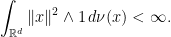
 .
. has the independent increments property if
  . More generally, we say that X has the independent increments property with respect to an underlying
  where
where  is a measure describing the jumps of X,
  ,
,  such that
  and
and ![\displaystyle {\mathbb E}\left[e^{ia\cdot (X_t-X_0)}\right]=e^{i\psi_t(a)}](https://s0.wp.com/latex.php?latex=%5Cdisplaystyle++%7B%5Cmathbb+E%7D%5Cleft%5Be%5E%7Bia%5Ccdot+%28X_t-X_0%29%7D%5Cright%5D%3De%5E%7Bi%5Cpsi_t%28a%29%7D+&bg=ffffff&fg=000000&s=0&c=20201002)
 can be written as
 ![\displaystyle \psi_t(a)=ia\cdot b_t-\frac{1}{2}a^{\rm T}\Sigma_t a+\int _{{\mathbb R}^d\times[0,t]}\left(e^{ia\cdot x}-1-\frac{ia\cdot x}{1+\Vert x\Vert}\right)\,d\mu(x,s)](https://s0.wp.com/latex.php?latex=%5Cdisplaystyle++%5Cpsi_t%28a%29%3Dia%5Ccdot+b_t-%5Cfrac%7B1%7D%7B2%7Da%5E%7B%5Crm+T%7D%5CSigma_t+a%2B%5Cint+_%7B%7B%5Cmathbb+R%7D%5Ed%5Ctimes%5B0%2Ct%5D%7D%5Cleft%28e%5E%7Bia%5Ccdot+x%7D-1-%5Cfrac%7Bia%5Ccdot+x%7D%7B1%2B%5CVert+x%5CVert%7D%5Cright%29%5C%2Cd%5Cmu%28x%2Cs%29+&bg=ffffff&fg=000000&s=0&c=20201002)
 ,
,  and
and  is a continuous function from
  to
to  such that
  and
and  is positive semidefinite for all
  .
.  is a continuous function from
  .
.  with
with  ,
,  for all
  and,
and,![\displaystyle \int_{{\mathbb R}^d\times[0,t]}\Vert x\Vert^2\wedge 1\,d\mu(x,s)<\infty.](https://s0.wp.com/latex.php?latex=%5Cdisplaystyle++%5Cint_%7B%7B%5Cmathbb+R%7D%5Ed%5Ctimes%5B0%2Ct%5D%7D%5CVert+x%5CVert%5E2%5Cwedge+1%5C%2Cd%5Cmu%28x%2Cs%29%3C%5Cinfty.+&bg=ffffff&fg=000000&s=0&c=20201002)
 for
for  is related to the fact that, for
  , the process hits zero. This idea extends to all continuous and nonnegative local martingales. The Girsanov transform method applied here is essentially the same as that used by Carlos A. Sin (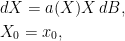
 , B is a Brownian motion and the fixed initial condition
  is strictly positive. The multiplier X in the coefficient of dB ensures that if X ever hits zero then it stays there. By
  is locally integrable on
  . Consider also the following SDE,
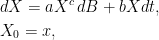
![{{\mathbb E}[X_t]=xe^{bt}}](https://s0.wp.com/latex.php?latex=%7B%7B%5Cmathbb+E%7D%5BX_t%5D%3Dxe%5E%7Bbt%7D%7D&bg=ffffff&fg=000000&s=0&c=20201002) , based on the idea that X has growth rate b on average. A more detailed argument is to write out (
, based on the idea that X has growth rate b on average. A more detailed argument is to write out (
![\displaystyle {\mathbb E}[X_t]=x+\int_0^tb{\mathbb E}[X_s]\,ds.](https://s0.wp.com/latex.php?latex=%5Cdisplaystyle++%7B%5Cmathbb+E%7D%5BX_t%5D%3Dx%2B%5Cint_0%5Etb%7B%5Cmathbb+E%7D%5BX_s%5D%5C%2Cds.+&bg=ffffff&fg=000000&s=0&c=20201002)
![{d{\mathbb E}[X_t]/dt=b{\mathbb E}[X_t]}](https://s0.wp.com/latex.php?latex=%7Bd%7B%5Cmathbb+E%7D%5BX_t%5D%2Fdt%3Db%7B%5Cmathbb+E%7D%5BX_t%5D%7D&bg=ffffff&fg=000000&s=0&c=20201002) , which has the unique solution
, which has the unique solution ![{{\mathbb E}[X_t]={\mathbb E}[X_0]e^{bt}}](https://s0.wp.com/latex.php?latex=%7B%7B%5Cmathbb+E%7D%5BX_t%5D%3D%7B%5Cmathbb+E%7D%5BX_0%5De%5E%7Bbt%7D%7D&bg=ffffff&fg=000000&s=0&c=20201002) .
. there is no problem, and
 ![{{\mathbb E}[X_t]<xe^{bt}}](https://s0.wp.com/latex.php?latex=%7B%7B%5Cmathbb+E%7D%5BX_t%5D%3Cxe%5E%7Bbt%7D%7D&bg=ffffff&fg=000000&s=0&c=20201002) holds.
holds. of dB grows too fast in X.
![\displaystyle {\mathbb E}[X_t\mid\mathcal{F}_s]<X_s](https://s0.wp.com/latex.php?latex=%5Cdisplaystyle++%7B%5Cmathbb+E%7D%5BX_t%5Cmid%5Cmathcal%7BF%7D_s%5D%3CX_s+&bg=ffffff&fg=000000&s=0&c=20201002)
 ,
, ![{{\mathbb E}[X_t^p]}](https://s0.wp.com/latex.php?latex=%7B%7B%5Cmathbb+E%7D%5BX_t%5Ep%5D%7D&bg=ffffff&fg=000000&s=0&c=20201002) is bounded over
is bounded over  .
. Almost Sure